Travelling Hopefully
06 January
My flight from Heathrow to Paris, where I would catch the long-haul flight to Cotonou, Benin, was scheduled for 11.30am. So I stayed at a hotel at the airport, which gave me time to for a leisurely breakfast before walking the terminal.
There was no queue and I was soon on my way through security. But as time went on, I watched my comfortable two hours to change planes in Charles de Gaulle airport whittle down. The flight left Heathrow nearly an hour late, probably due to the snow conditions both in London and in Paris. Fortunately, my next flight was in the same concourse, so although I had to go through security again (why?), quick walking brought me to my flight just before boarding began. I did fret about my luggage making it, but this flight was also delayed, by around 40 minutes, and the AirFrance app let me know that my case had been loaded on board.
We landed in Cotonou around midnight. Immigration checked our visas as well as our Yellow Fever vaccination certificates (first time I’ve ever had to show it, although I had the vaccination in 2013). Collected my case, went through customs (everything was scanned), and my shuttle driver was waiting for me. I tried three cards in the ATMs at the airport, and all three were rejected, so I paid him by US dollars (overpaid, really) rather than the local currency.
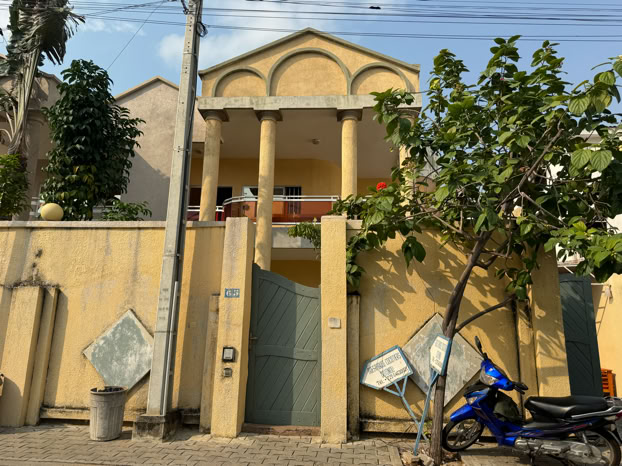
I’d booked a hotel near the airport, a cheap and cheerful one (but with character), as it was much less expensive than what the group was using the next night onwards. I paid the extra for air conditioning. It was quite a shock to the system, coming from sub-zero temperatures and snow in England to 32c, hot and humid. The air conditioning took awhile to cool my bedroom, but I managed to get to sleep.
One of our group was facing a much more difficult journey. She had planned to fly from Birmingham to Paris, then on to Cotonou. Her Birmingham flights were cancelled Monday and Tuesday. She tried to catch the Heathrow flight on the Tuesday but arrived too late.
07 January
I had booked breakfast at the hotel, which I ate outside in the company of a couple of other occupants. One was from Ireland and was on a motorbike trip. The other was from Berlin and cycling across parts of West Africa. She was stuck in Benin waiting for her visa to Ghana to come through.
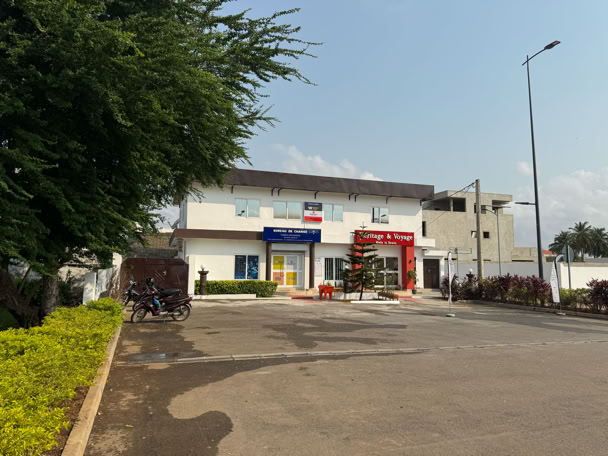
I needed local currency to pay for the hotel and the breakfast. The Irish man pointed me in the direction of an ATM and a money exchange bureau. The ATM refused to accept any of my cards. I walked the half mile to the bureau, where I exchanged US dollars and UK sterling for local currency. Once back at the hotel, I was able to pay for my room. Sadly, as no one in the hotel had any change, I ended up underpaying for the breakfast.
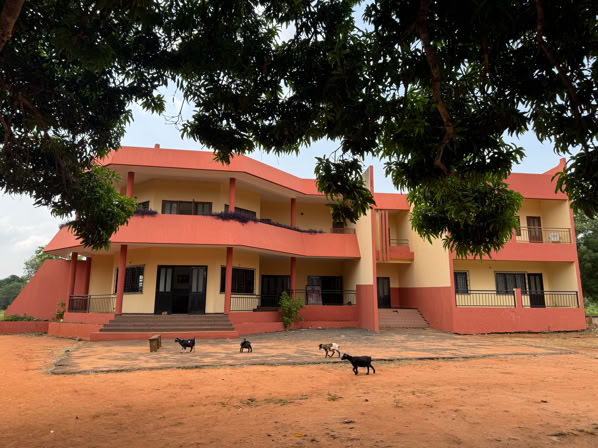
A van came to collect me at noon and I was taken to the Ibis Hotel, where our group was booked to stay. Air conditioning was already on in the room, which was fitted out better than the previous hotel but not as interesting. And the wifi had worked better in the cheaper place! I settled in and did some reorganisation of my packing.
At 4pm I joined the group in the reception area. Although there was meant to be six of us, two people had pulled out due to medical reasons. So including our photography guide we were four, with one more about to catch her flight to Benin. We were introduced to our local guide and our driver, both of whom were splendidly dressed in bright clothing.
The van which we were to use for our trip was old and those with long legs found the seating challenging. There was working air conditioning though, which was put on as the day was still warm. We drove to the beach and had an excellent fish dinner with local beer. The breeze was very welcome and we swapped travel stories.
08 January
I rose at 6am for a 6.30am breakfast. We left the hotel at 7.30am, grey clouds overhead but already quite warm. Fortunately our guide had insisted on a change of van, and what we now had was modern and comfortable, plenty of room for us and our luggage. Our last group member had finally managed to catch flights to Benin and was with us in the morning.
We were asked for our lunch choices and we stopped at the venue to hand these in, and to use the toilet facilities. The passing countryside was greener than I’d expected, and like other African countries I’ve visited, the roadside was occupied by casual walkers and casual rubbish.
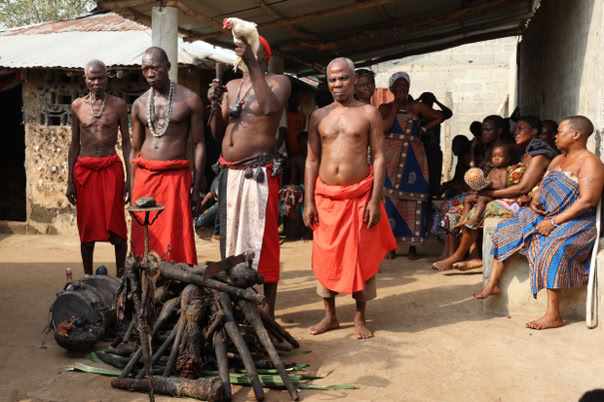
Around 10am we arrived at a village for a ‘judgement’ ceremony called shango. Although this was put on for us, most of the village (and in particular the children) joined us. In the past, the skulls of dead convicted criminals were used to punish the guilty. By sacrificing chickens and alcohol, and lighting gunpowder by the skull, criminals would have bad luck happen to them through the god of judgement, lightning, and thunder.
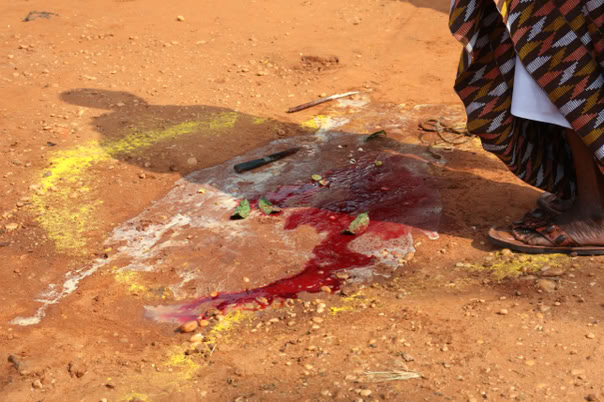
We were shown into a courtyard where the priests started the ritual. The chicken was waved over the collected pyre. The moment of sacrifice was behind the sticks, so out of sight, but the hen made one protesting squawk. The headless chicken was then lifted back into view, and blood was dripped on to the pyre and area around. The woman chanted and danced at various times while all this was going on, and we were offered some of the alcohol. I had a small sip of the moonshine, very strong and colourless.
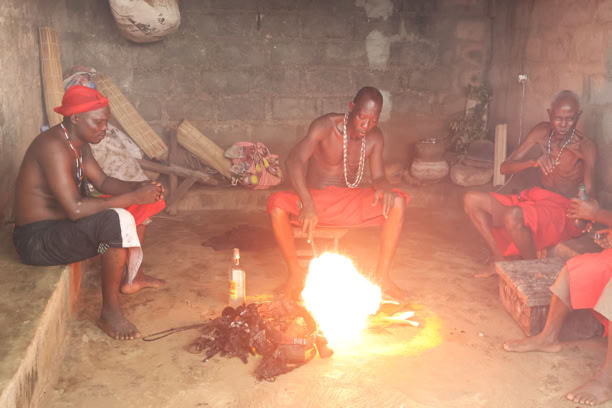
The priests moved on to another area, where the skulls were set up on the floor. Another chicken was brought, protesting as the man cut the binding free from around the legs. This time, the throat was only slit, rather than the head removed. Again blood and alcohol were offered to the skulls. The first time the gunpowder was lit, one of the group was asking a question, so most of us missed the moment. Fortunately, the priest repeated the action, so we managed to catch the explosion. He refused to do a third one.
To my delight, we found a praying mantis, one of my favourite insects. I let her pose on my finger for people to take photos before putting her safe into a bush.
After numerous more photos of people and the area, we climbed into our van. Our next stop was at the palace (well, very grand house) of King Agassa. He’s the spiritual leader of Voodoo in Benin, and our guide emphasised that meeting him was like meeting the Pope (‘Or the Archbishop of Canterbury’ I suggested). We waited awhile, taking refuge in the shade, photographing various passersby whilst we waiting.
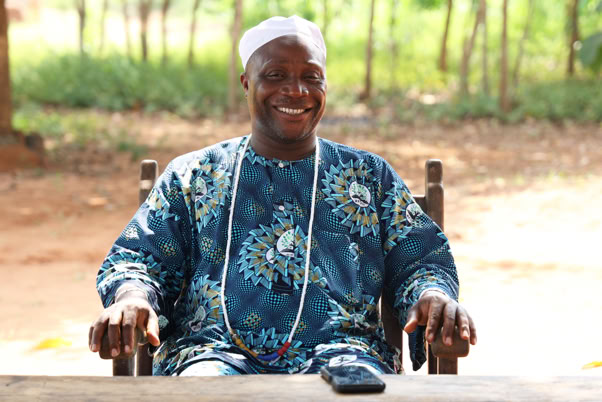
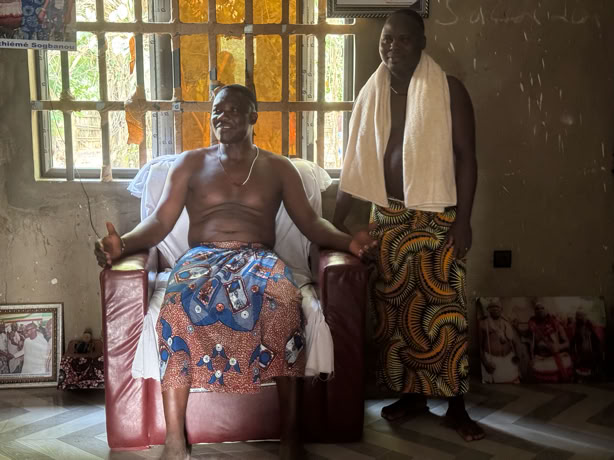
Benches were put out for us and the king appeared. We asked a few questions of him through our translators, discovering that he has three wives and eight children. His second son is due to succeed him as king, because the spirits chose him rather than one of the other sons. Some of the group had hoped for a more involved visit, but I liked the low-key of him just sitting behind a table smiling at us.
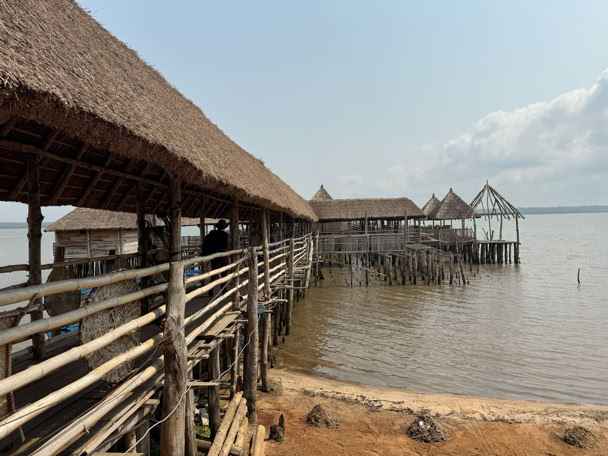
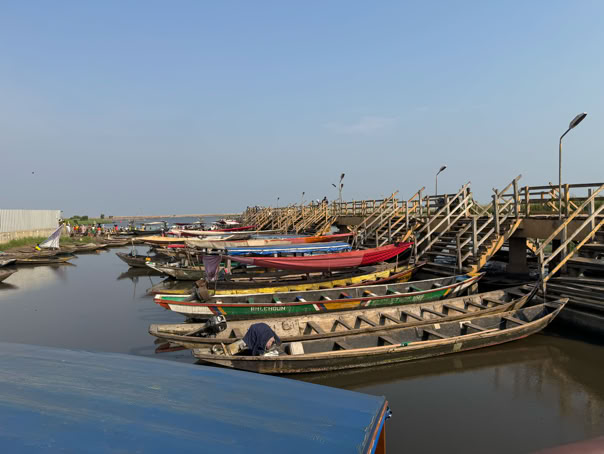
Lunch was on a pier on a lake. I had rabbit with couscous and fried plantain. Our guide gave us a talk about photographing the various festivals and what we could expect to see. We went to our hotel to check in, where there was some chaos. All of us were taken to one area, which were like holiday flats with two bedrooms leading off from a common area with a kitchen. We were happy to share such flats, but this didn’t seem to meet with approval. So I was taken back to the main building to my own room. It was very hot, and I put on the air conditioning for the 30 minutes we had as a break.
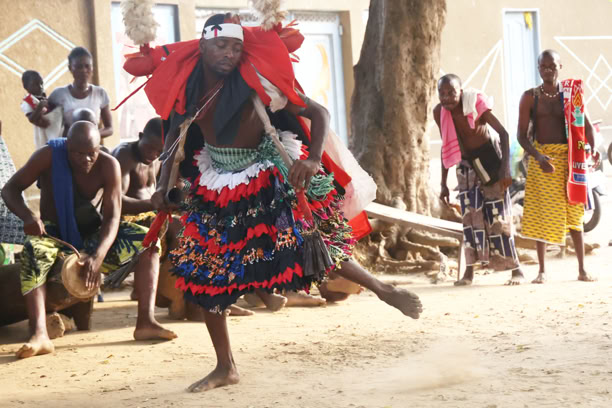
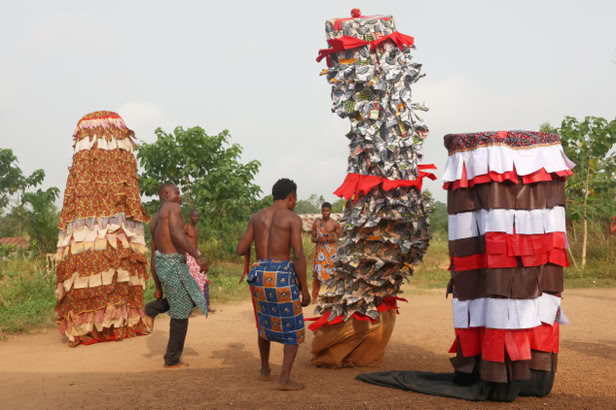
At 3.30pm we headed out again, this time to a different village. There we waited for an hour before the egunguns appeared. These are masked dancers who carry ancestral spirits. Each has a guardian, who protects them from being touched as doing so can cause one temporary death. Children run from the egunguns if they get too close.
When they appeared, there was some stage management by a person from the village. The dancers and the men accompanying him were sent back up the path to dance their way down. A second egungun appeared to also spin and dance. We followed them into village, along with excited children, where two more egungun emerged. We were instructed to take a seat on benches, and one of the guardian’s sticks was placed in front of us as protection before the egunguns danced just a few feet away. Men and women chanted and sang. Chickens wandered past, some with ribbons tied to one wing to show who owned the hen. Other people and children stood just behind a fence to watch.
Afterwards the egunguns willingly posed for photos, although we were warned not to stand too close. One of the guardians usually placed his stick between us and the egunguns.
The sun was beginning to set as we headed back to our hotel. We had around an hour to freshen up. The electricity in the room is one of those which only works when the hotel key card is put into a slot, which meant the air conditioning had switched off whilst I was away. I had a shower, but my shirt was sticking to my back by the time I went down to dinner.
Dinner was filet mignon with small roast potatoes. Lots of garlic and herbs, very tasty. Dessert was a large fruit salad. I had a small beer with the meal.
Afterwards it was back to very hot room to work on the photos from the day.
09 January
A very hot and uncomfortable night. The air conditioning struggled to bring the temperature down.
We met at 7am to drive to a cafe for breakfast. This consisted of powdered coffee (I forgot to take a coffee bag with me), an omelette, and a half stick of french bread, along with a glass of pineapple juice. Whilst we ate, a storm blew in. Just after we boarded our van torrential rain hit.
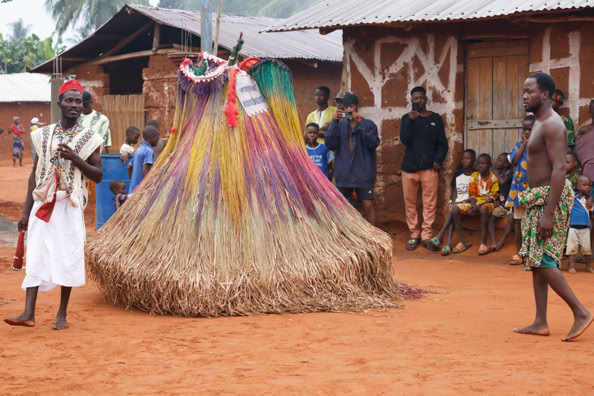
It was around an hour’s drive to our first stop, by which time the rain had eased off to droplets. We joined villagers in their celebrations, which consisted of singing, drumming, dancing, and zangbetos. The latter look like large haystacks, and are supposedly moved by spirits. When one is upended, it’s found to be empty inside. We saw this for ourselves, along with one producing two smaller zangbetos after being upended.
The zangbetos charged around the area, and it was important to keep an eye on them as they did bump into people. I found them both charming and slightly eerie. We were the only Westerners and the locals were equally interested in taking photos and videos of the proceedings.
I asked about toilets and was taken to a clean stretch of soil at the end of a building. It was okay for a liquid deposit, but I do wonder what I had been meant to do if something more substantial had been my gift to the village. I couldn’t see any way to dig a hole and of course there was no toilet paper. Rags hung off the wall but I had no intention of using one of those.
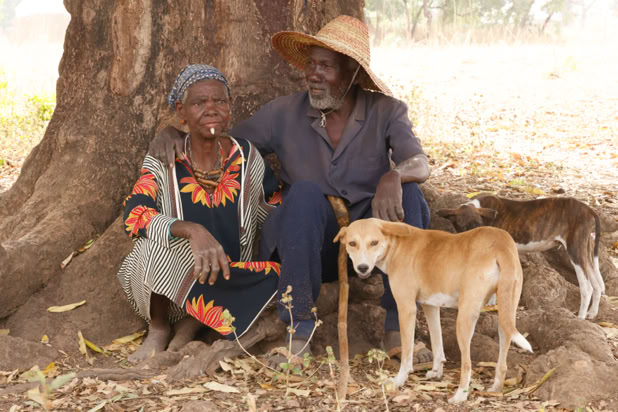
We wandered into the village afterwards, meeting a man who claims to be 120 years old. Sheep and goats (the goats here are very small) wandered around as did the usual chickens. A few small dogs slept in the humid heat.
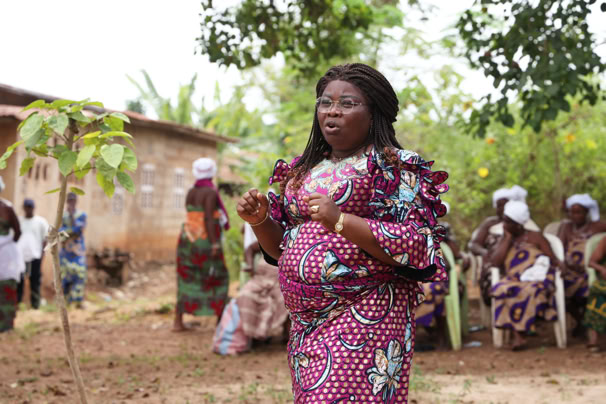
Returning to our van, we gulped down cold water as we headed off. The site our guide had hoped would have a festival was empty, but as we drove away we came across a vodun priest. We gave him a lift to another festival, which featured mostly women, sitting down to sing and to ring bells. We all had to have our palms washed with herb-infused water before we could join the group. Part way through a candidate for the upcoming elections spoke to the crowd. Although I couldn’t understand a word she said, she definitely delivered it well and people cheered regularly throughout.
‘I think this was for the local elections,’ I told one of the group.
‘Local erections!’ she exclaimed. I laughed and repeated my original sentence. Around three minutes later, a woman appeared waving a wooden fake penis at us.
Lunch was at the same lake restaurant as the day before. I had prawns in garlic with a side of plantain.
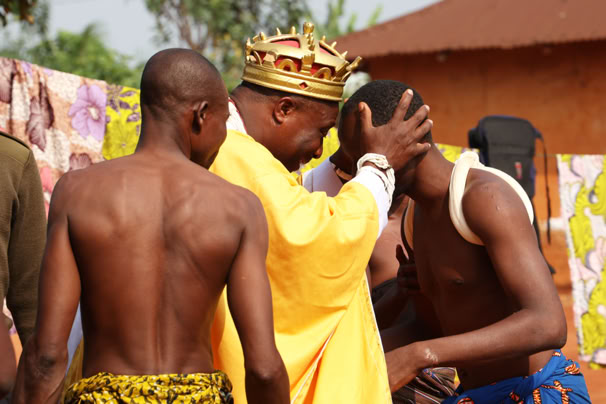
We drove to the village of the king’s residence, and joined the crowds chanting as they marched to his house. Dances and singing of various types took place on the grounds. We discovered that if we presented ourselves at the house entrance, we were permitted to go into the first room, where King Agassa was sitting on his throne, under an image of his father. He was interviewed at one point.
We returned to our hotel as the sun set.
10 January
We headed out after breakfast with the intention of going to the king’s compound to see what might be happening there. Today was the Vodun Festival, and we thought he might be there preparing for the event.
As we drove, we came across a celebration. Upon disembarking, we discovered that King Agassa was walking down the street, surrounded by excited people. We followed him until he climbed into his car. We set off after him, joining him in a village where he paid homage to the places in which zangbetos lived. Following him to the next village, we were all warned back from following him to the toilet!
After his comfort break, the king assisted in pouring the blood of a freshly slaughtered goat on to various designs on the ground. People asked for and where given his blessing. We continued to go with him to a third village, at which he paraded through. At each stop, men played trumpets and trombones, travelling with the king in the back of his large vehicle.
Deciding we’d been groupies for long enough, we headed to the Vodun Festival grounds. Chairs were reserved for us, but we ventured out into the heat to take photos of the attendees. Various groups came in singing and dancing before heading to plastic chairs. Children wandered past, carrying drinks on their heads for purchase.
We left to get some lunch. I felt little hunger, but ate some pork and plantain anyway. During the next couple of hours, I began to feel unwell. I tried to eat mints and convince myself that I’d be okay.
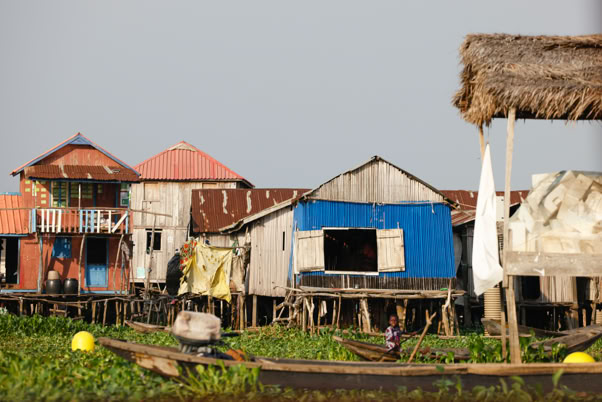
Our destination for the night was Ganvie, a community which lives on the lake. During slavery times, no slaver would try to cross water to catch someone, hence the reason for living there. There are now 20,000 inhabitants. A motorised boat was arranged to take us over to the village.
My stomach finally decided that mints were not going to make a difference. I went to one side of the dock area and lost my lunch. A child came up to me offering me water, bless her, and another came close to pat my back.
I managed to keep everything down for the 30 minute trip to our hotel. There, I didn’t make it to the toilet in time, so a railing over a lake helped me to rid everything into the water. Unfortunately, the other end of the digestive process also decided to revolt at the time, and the results were revolting. I managed to find the toilet and did my best to clean up and took some diarrhoea tablets.
There was no running water in the rooms, nor electricity. I cleaned up in the shower area by dipping a bowl into a bucket of water. After I’d changed, I handed my soiled clothing (in a sealed plastic bag) to our guide. The hotel had agreed to wash and dry everything for me.
The group were going out on canoes to visit the area. I crawled on to the bed, which was a mattress on a concrete platform but surprisingly comfortable. With no electricity I couldn’t put on the fan, so I left the door open to allow in a breeze.
The electricity was put on in the evening, so fan was employed. I slept rather well, in the circumstances.
11 January
There was a photo opportunity at dawn which I missed, staying in bed until 8am. My laundry came back clean and dry. ‘I’m sorry it’s not ironed,’ our guide said! It also emerged that only one member of our group was not also suffering from some level of digestive upset.
At 9am we boarded our boat and headed out. We stopped for some boys to come out to us, singing songs and drumming whilst four of them did fancy work with short oars, splashing them in the water and lifting them overhead. We followed them back to the main entry area, where they continued for a short while before taking off.
We returned to our van and drove off. Around 90 minutes later we stopped at an old, and closed, mosque. I had another unfortunate incident. I found a wall to crouch behind for some cleaning up, and when I boarded the van I put a plastic bag down on the seat.
At our lunchtime restaurant, my bag was carried into an indoor eating area which had a toilet. There I was able to change into fresh clothing and use water for a better wash down. I picked my lunch, eating only the rice, and took more diarrhoea tablets.
We drove into the countryside to visit a couple of villages where the people still practise decorative scarring. Several of the elders allowed us to take their portraits, showing the scars on faces and stomachs. We also saw a woman nursing twins. Twins are more commonly born in Benin than other countries, and they are considered good luck.
The heat was oppressive, 32c but (according to the weather forecast) feeling like 39c. I headed back to the van, where another member of our party had decided to stay. He too was suffering.
We reached our hotel around 5pm. To my great joy, the air conditioning was powerful and we had real keys, so the electricity would stay on when one left the room. I had a proper shower and washed my trousers (today’s incident was not as bad as yesterday’s).
Dinner was in the next door restaurant. I forced myself to eat the ‘vegetable spaghetti’ which seemed to have some version of a curry sauce. The meal took 45 minutes to arrive (despite us having pre-ordered) and a member of our group went to the kitchen to cancel his meal. He was just in time to see a rabbit being slaughtered, which explained the strange high-pitched noise we’d heard in the restaurant. Shows the meat was being served fresh…
12 January
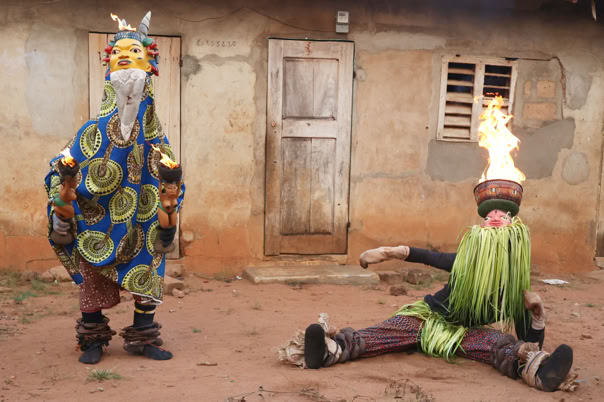
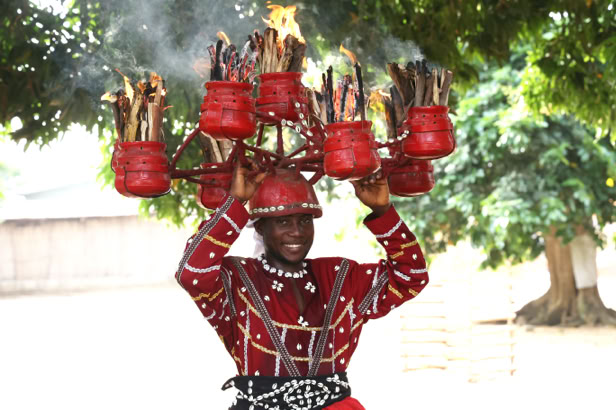
A good night’s sleep due to the wonder that is air conditioning. I rose at 6am for our 7am departure. We drove a short distance to watch a fire ritual, which consisted of two masked dancers with flames on heads and puppets. One reached into the cauldron on his head and threw out embers. I’m assuming his gloves were specially designed to handle hot items.
We had breakfast at the hotel restaurant, a garlic infused omelette and bread. I was happy to have one of my coffee bags with me instead of using the offered powdered coffee.
The day before, when we were all suffering from our digestive complaints, the only person who wasn’t stated ‘Well I’m fine thus far.’ I suggested, ‘Don’t jinx it.’
Said person was ill through the night. She came to the morning ceremony but skipped breakfast. At 8.15am we headed out again, and she came with us.
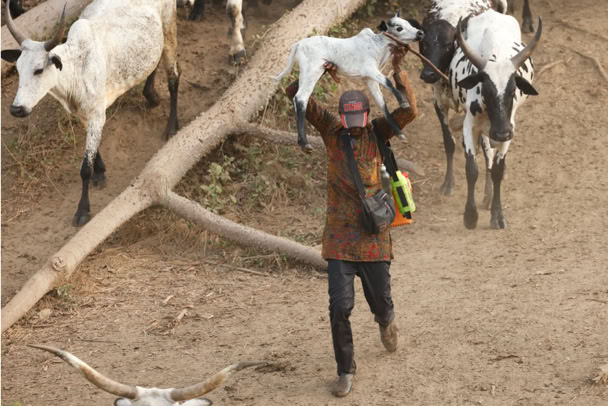
We had an unexpected halt at a road bridge. Herd after herd of cattle were being herded through woods and under the bridge. The men stopped to place small, struggling calves on their shoulders. The morning light was lovely on the white hides.
We drove on to catch a canoe to a fishing village, where we wandered with our usual guide and a local woman. People were on the whole happy enough for us to photograph them as they went on with their daily lives. Fishing nets and washing were hung out to dry, and the smell of cooking fish pervaded the area. The narrow areas between houses offered some relief from the building heat. Our ill-feeling companion stayed behind, taking a seat in the shade.
After an hour, we headed back by canoe. And our group member was sick over the side as we neared our disembarkation point. She managed to make it back to the hotel without incident, but decided not to join us for lunch nor our afternoon excursion.
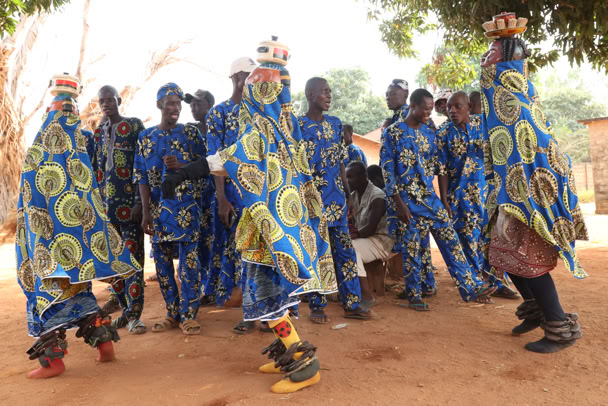
We had time in our rooms before and after lunch, during which I caught up on photo processing. At 3pm we headed out, back again to the local village. We visited a mask maker, and our guide bought one at what seemed to me a good price. The villagers had put out benches and a padded sofa for us to sit on to watch the main event, the Guèlèdè festival. This is a celebration of women, although all the dancers are men.
A group of men and, as the afternoon went on, women danced and sang to drumming. Although most were in the colourful Benin clothing, a number of men were in regular Western clothes. Our guide asked for those men to leave the group. Some went off and put on the more traditional clothing before returning. Others refused to leave.
One by one masked dancers emerged, parading around the group and doing footwork in front of us. Metal bangles on around their ankles rattled and chimed in rhythmic notes. Some of the masks had puppets on top, which the dancers controlled with strings which ran down to their hands. One even had what I assumed was meant to be a Christian, bowing down to cross. This one picked up another puppet, a man, and placed him on his shoulders.
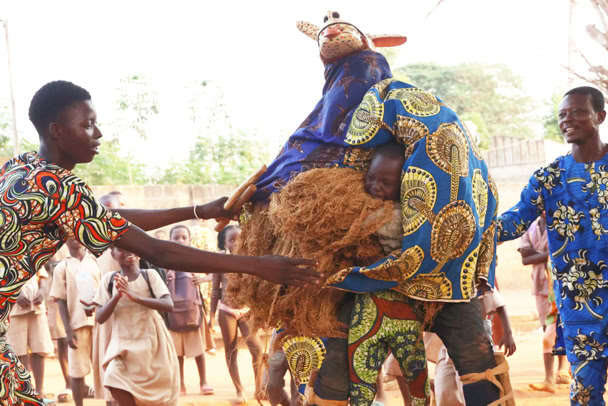
The entire ceremony took around two hours. Near the end, a dog dancer emerged. He was naughty, rolling around our feet before taking off on stilts. At one point, he suddenly grabbed a small child and charged around with him. The other children, who had gradually increased in number during the course of the afternoon, scattered at his approach. When the child was taken from him, the lad was bawling, terribly upset. Our guide did her best to comfort him. Other villagers grabbed the dog dancer and carried him away.
We headed back to our van and to the hotel. Dinner was at the same restaurant, with the same meal options. I had the same as at lunch, namely couscous with vegetables. One does not come to Benin for the food, obviously.
13 January
Another early start, 7am departure. Our ill group member clambered on to the bus, looking definitely pale. She noticeably improved through the day, including having some breakfast when we stopped at a restaurant at 8am. The place offered a wide variety of French style baked goods and sandwiches. I had the chicken sandwich, along with a very sweet cappuccino. I ordered another sandwich to take away for my lunch.
A long driving day. We stopped to look at cashew trees, never before realising that a single nut forms at the bottom of the fruit. We also viewed the Dankoli Fetish. This is a site of pilgrimage, at the roadside, for those of the voodoo religion, and is the largest forest shrine of voodoo in the world. Sacrifices are made here (there were many chicken feathers drifting across the hard ground) for luck. Palm oil is poured on various figurines, and in the heat had turned rancid, adding an extra layer of unpleasantness to the surroundings.
A dead rat was laid out near a small cooking pot nearby. The couple which had killed it seemed a bit embarrassed by it at first, the man snatching it away. The woman and the man argued with each other after she held it up for us to see, and in the end he held it up as well. They were going to cook and eat it later.
Lunch was at a hotel, where to my surprise it was okay to bring in our own food.
We were heading north, and into an area which is marked amber on the Foreign and Commonwealth Office as ‘essential travel only’. For that reason we were asked not to put anything on social media for several days. The countryside became a bit drier and more Muslim, with plenty of small mosques to be seen and women wearing head coverings. Although the temperature, around 36c, was the same as further south, the humidity dropped dramatically making for a much more comfortable climate.
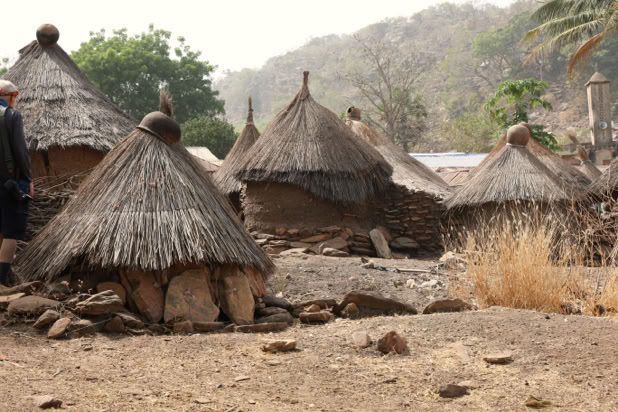
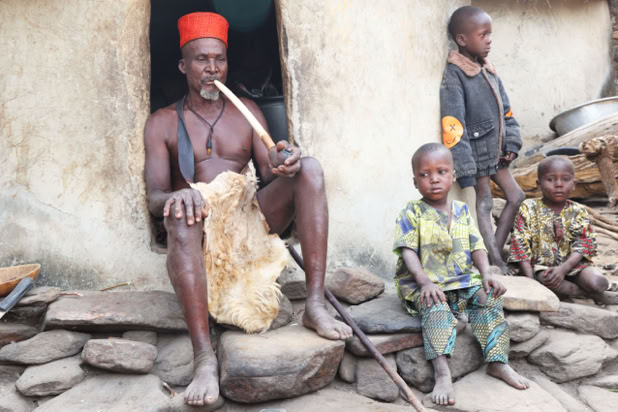
We stopped at a small village to view the interesting round huts and meet the local people, the Taneka. The families cannot afford to send their children to school, so we had quite a following as we walked through. The children wanted to hold our hands. One carried a styrofoam box the entire time.
The local king met us in his throne room (a small building with a concrete dais). We were allowed to leave our shoes on but were asked to stand as he entered. He is king over around 1500 people, in effect more like a chief or a village elder. We were able to ask some questions through interpreters. When I asked what had been the greatest change he’d seen during his reign, the response was the falling away of people following traditional ways. We also had the opportunity to buy locally made carvings.
We walked further into the village, visiting the king’s palace (a small building around the same size and state as everyone else’s). The larger palace area had been burnt down a few years ago, and the king was hoping that the government would fund the rebuild. We also took photos of various people. Money was handed over for these and to the king.
It appeared that one group of tourists had visited just before us and perhaps another was to follow. At our van, our guide signed what looked to be some official record of our visit.
We arrived at our hotel in Naititingou around 5pm. The complex encircled a garden and pool area, very pleasant. Great air conditioning and good wifi in the reception area (the signal struggled to reach my room). I took dirty clothing to reception to ask for laundry to be done. To my embarrassment, the man dumped everything on the floor to look through and to note down what he’d taken in. I was advised that it would be returned to me the next day.
Dinner was outside in very comfortable temperatures. Our local guide had gone to fetch food from elsewhere, rather than using the hotel restaurant. What he brought was pineapple slices plus three plates of fish with varying sides, namely spaghetti, couscous, and rice. We split the amounts between us.
When I returned to my room, I actually turned the air conditioning off!
14 January
There was a knock on my door at 7am. My laundry was returned to me, clean but slightly damp. I spread it out in the room to dry. The deliverer advised me to take the bill (6700 Benin currency it looked like to me, around £9.00). I reported with the bill at reception, and handed them a 10,000 note. I was given 5000 as change. I did try to query this, but seemed to be told that this was correct.
We didn’t leave until 8.30am. Breakfast was in the comfortable temperatures outside, made of the usual bread and omelettes with the addition of croissants, real coffee, and a small pot of yogurt.
The area is known for the style of building called tatas. These are traditional, two storey fortified mud houses. Livestock would have lived in the bottom floor, and the humans on the next level. They’re made from mud, wood, and straw.
During the morning, it quickly become obvious that we were on the tourist route. Our first stop, in a small village, featured only us as we visited one restored tata and walked through the area. At the next stop, we were meant to immediately be welcomed by a dance performance. However, a large group of Europeans had arrived before us and, upon seeing white faces, the women had thought this was the group they were waiting for. Our photography guide was annoyed as we waited for the performance to end. ‘That is our festival,’ she said, ‘which we have paid for.’ In the meantime, we took photos of a distant tata, puppies wrestling, and passing pigs.
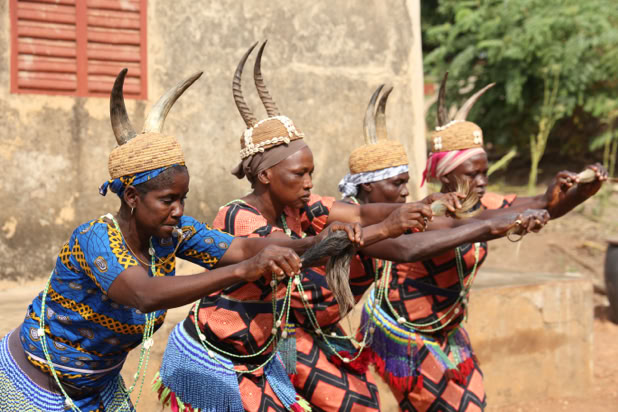
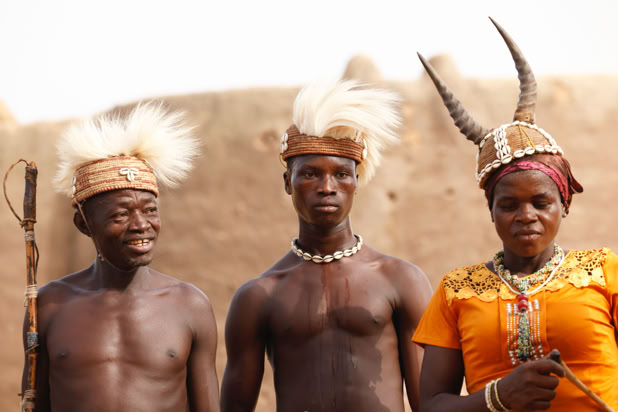
The other group moved on and we went to the dance area. The women gamely did their dances again, a number of them wearing hats with animal horns. We were able to walk up and stand on a stone platform to take shots from above. I enjoyed the shadows cast by the women’s hats.
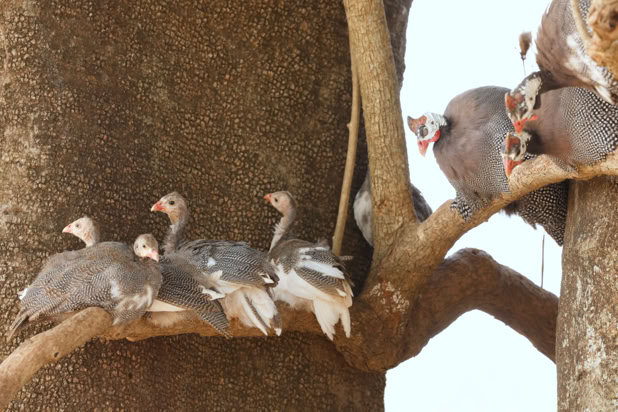
Afterwards, whilst the others took portrait shots, I wandered off and found a small flock of guinea fowl chicks and their mothers sitting in a nearby tree. They were a bit concerned as I took photos, but remained where they were.
We drove through a misty valley to our restaurant for lunch. Arriving at noon, we discovered that the cook was still in preparation mode. We took cold drinks to sit at a table in the shade. Again the temperature was pleasant. An hour later, at the same time that the large group arrived, food appeared. Chicken, vegetables, rice, all very tasty. Our local guide joined us and, to our amazement, ate the whole of a chicken leg, including the bones.
One member of our group asked our local guide, ‘Do you eat dogs?’ His response of ‘Of course we do’ was uttered as if he couldn’t comprehend when anyone wouldn’t. He made a motion which seemed to indicate that he found the meat very tasty. We hurried to advise him that none of us wanted to try eating dog!
Afterwards we drove the border with Togo. We met an elderly woman who wore an ornament in her lower lip, taking photos of her. She took us into the nearby tata, then suddenly seemed to change her mind and drove us out again.
Aware that our local guide had arranged ‘a surprise’ for us, we hung around the area for about an hour. Children and others waited with us. Without our local guide, we had no way to communicate with them, and we thought the elderly lady was trying to get rid of us. In the end, when our guide returned, it seemed she actually was asking us to take her with us.
The surprise was a group of dancers from Togo. They turned up on a small truck, changing into their costumes before going down to perform in front of the tata. The dance, we were told, was one done before the initiation ceremony, when boys became men. The women wore the hats with animal horns and the men hats with animal hair which waved as they danced.
The elderly woman kept wandering into the area, dancing with the men and sometimes trying to tell them what to do. After the performance, the women invited members of our group to come and dance. I declined, but several others put on the hat appropriate to their gender and did their own performance.
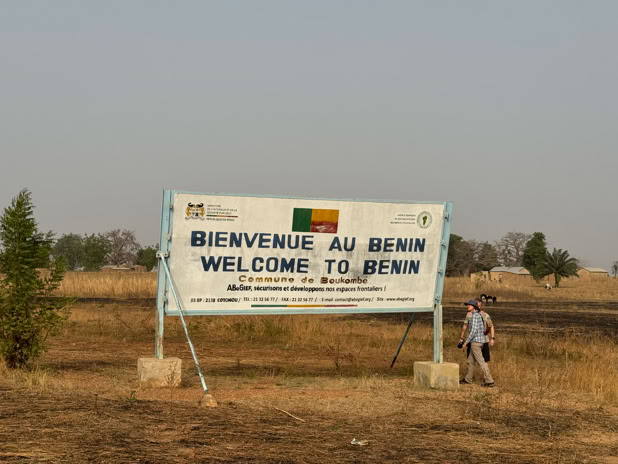
After some portrait photography, we packed up and drove into Togo. Well, at first just past the sign which stated ‘Welcome to Benin.’ At first the van stopped part way across, and I pointed out that the two members of our group at the back of the vehicle were still in Benin! We got out and took a closer look at the sign. Afterwards, we headed back to our hotel. Several people in our group bought souvenirs from a man who had a table set up outside the hotel, selling masks, wood carvings, and necklaces.
Again, a pleasant evening outside. I had beef in mustard sauce with pasta for dinner, and pineapple slices for dessert. Later on, a young boy and his mother were brought to meet us. Several years ago, another group led by the same travel company had come across the boy. He had bowed legs and was unable to walk properly. The group raised enough money for him to have an operation, and he can now walk and run the same as any other child.
15 January
Breakfast outside at 7am. We were due to leave at 7.30am, and as I exited my room a man came up to tell me that I owed money for the laundry. I tried to explain what had happened at reception, but the man was adamant that I owed another 1000. I only had a 5000 and a 10000 on me, and he had no change. No one else seemed to have change either. Our local guide had a 2000 note, which I handed over, and 1000 was given back.
We drove east. After two hours, our local guide found us a toilet break. We drove into the grounds of a Catholic church, and the priest allowed us to use the facilities off his own bedroom. Afterwards, a woman there spoke to me in English. I’d spotted that the painting in the office area was of the conversation of St Paul, and that the icon was of St Joseph and the infant Christ. She asked if I were Catholic, and I did my best to explain that I was Church of England, Protestant, but my sister and family were Catholics. ’Why aren’t you Catholic?’ she asked. I wasn’t certain that we had the time nor the language ability to discuss that topic. The priest asked if we’d like to stay for a coffee, and we explained that we had to drive on.
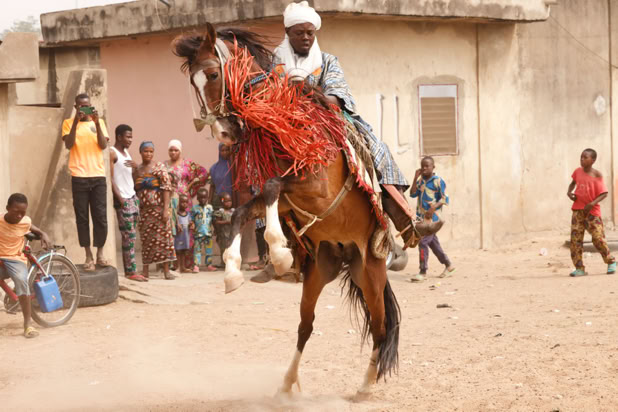
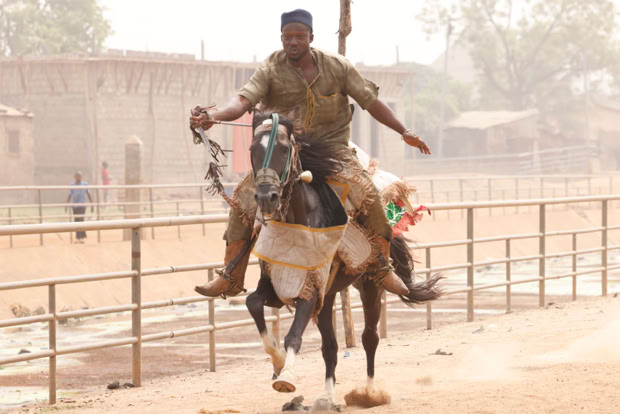
We arrived in Parakou around 11.30am. Our morning’s challenge was to photograph the Bantou horsemen. During our drive through the city we saw representations of the highly dressed men on rearing horses. When we arrived, in what was like a back street but with stables (and a veterinarian’s office), we found the horses tied up and the men getting ready to perform for us.
‘What shutter speed should I use for this?’ I asked our photography guide. ‘Depends on what you want,’ she said. ‘If you want to freeze the action, then you need to go higher.’ In the absence of any greater guidance, I decided to go for 1/5000 of a second, as the bright light meant that I’d still not have a high ISO as a result.
We started off in the side street. The men took turns galloping the horses past us, dust kicking up by churning hooves. I soon learnt to concentrate on the far end, as this gave a more uncluttered backdrop, free of people and motorcycles. Some of the riders made the horses ‘dance’, moving them sideways and making them rear in sync with the drumming. We had to keep watch. A couple of times the horses came very close to us and we had to quickly move out of the way.
After this, we moved on to the area at the bottom of the street, near a river canal. The horses charged down a track parallel to the canal, kicking up more dust. Mostly this was one at a time, only once did a pair charge down together. By now a crowd had formed, the children in particular clapping at the spectacle.
A few last bits of dancing and rearing, and the riders headed back up the side street. We took more photos, but were a bit disturbed to see that a number of horses had blood dripping from their mouths. A couple of horses were then relieved of tack and were washed down outside. Other horsemen headed into town, and we passed them later in our van.
Lunch was at our hotel. I had spaghetti bolognaise, the sauce cold and spicy so I concentrated on eating the pasta. We took our bags into our room, and had an hour before we headed off again at 2.30pm. This was to visit the Fulani people. We drove down dirt tracks, overhead branches scraping at the roof of our van at one point.
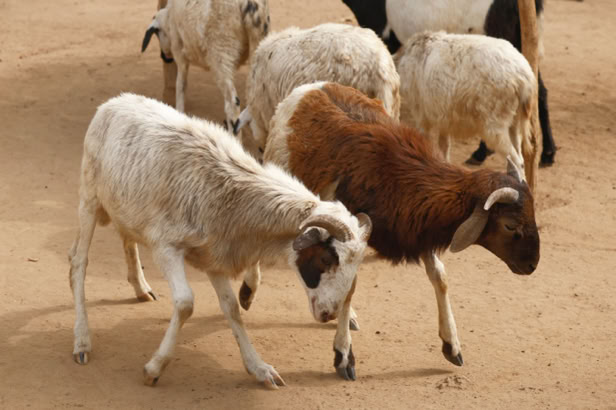
The Fulani are known for their colourful clothing and facial decorations. We arrived and as usual there were plenty of posing for photographs. As my appetite for portraits was beginning to wane, I amused myself by taking photos of goats head-butting each other and stealing food. One ram was closely following a ewe, and drove off any other ram which showed an interest.
After some while of photography, the children did some clapping and singing. They were given their supper. We hung around for a while longer, our photography guide continuing to take portrait photos, which is her particular interest.
Most of the village followed us back to the van. I managed to sneak off to duck behind a bush to make myself comfortable for the drive back to the city. I had to push through the huddle of children to get into the van. They seemed very reluctant to see us leave.
Dinner was takeaway, ordered and brought to the dining area of the hotel. I had gone for something called a ‘buffalo burger’, which turned out to be chicken with a very spicy sauce. I couldn’t eat much of it. I had some green beans and ate the French fries. As I’ve commented before, it’s obvious that you don’t visit Benin for the food.
16 January
Woke up with the beginnings of a migraine. I took ibuprofen, which slowly eased the symptoms. By breakfast time I was able to eat the bread and pineapple offered, along with a cup of coffee, but I skipped the omelette.
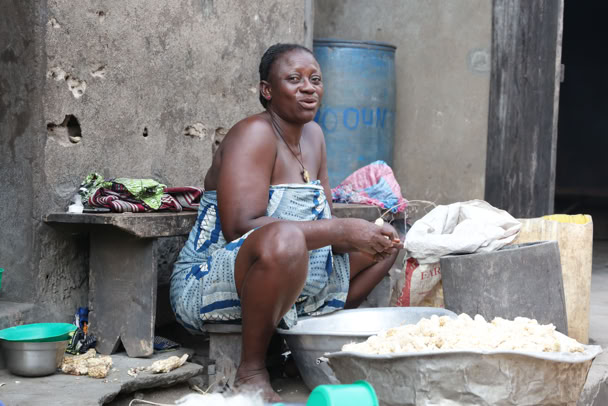
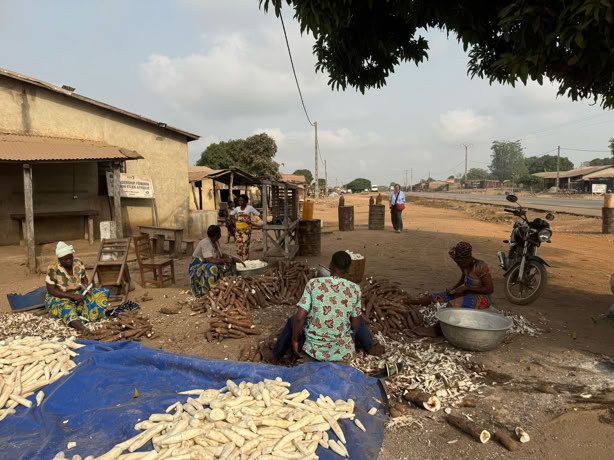
We had a three hour drive to our next destination, Dassa. Along the way we stopped for a short while at community set up along the roadside. They were peeling roots and seemed quite intrigued that we would want to meet them. A man who spoke English came up to practice his language skills with us.
Around noon we arrived at our hotel and checked in. There was a lift, which has proven rare in our hotels, and good air conditioning. The wifi signal didn’t extend to our rooms, however, so our guide had to come door to door with our lunch options. I went for the same chicken sandwich I’d enjoyed on the way up at the restaurant next door to the hotel.
We had time to relax, not heading out again until 4.20pm. I worked on photo processing, trying to choose between many images of galloping and dancing horses.
The ceremony we’d hoped to see this afternoon was actually taking place the next morning, so our local guide had found out that a nearby village was having a voodoo celebration which would include trance dancing. Just a short distance from the area, there was a tricky bit of road, with a large section of concrete protruding from the ground. Although we tried to suggest to the driver that we could get out and walk, he drove over the obstacle. There was a sickening sound of metal being scraped. We got out to see that part of the exhaust had been torn loose.
We walked to the village, which took all of two minutes. The villagers were busy preparing the meal, pounding out cassava and, around the side of one building, skinning and gutting a number of goats and cattle. We’d picked up a pair of additional guides, and one of them spoke excellent German. He had studied it at university and spent time living in Berlin.
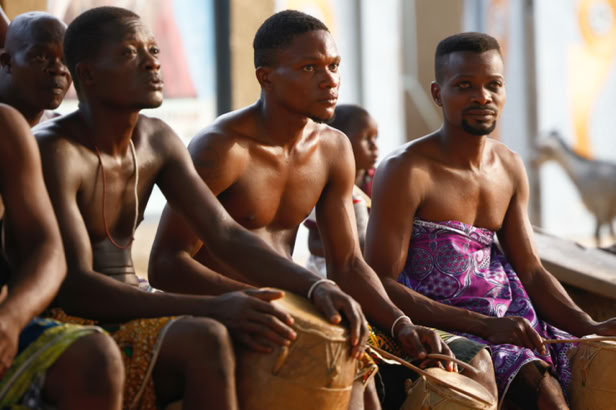
The drummers started soon after, set up at one end of a tented area next to the voodoo temple. We were given chairs in prime watching position. The priest appeared briefly, his face painted white. Some of the dancers also wore white paint on their faces. We saw one woman definitely in a trance, others simply seemed to enjoy a time on the floor, including some young toddlers.
As the light faded we decided to head off. We made a brief stop at the temple at which tomorrow’s ceremony is to take place, confirming the start time of 8am. By the time we returned to the hotel, our dinner was ready. I enjoyed my chicken skewers with vegetables, one of the better meals I’ve had here.
17 January
A 7.30am departure to go back to the temple for their 8am ceremony. I have to admit, I had my doubts that this would actually start at 8am, and my doubts proved correct. When we arrived at 7.45am, all we saw were a few people sweeping away leaves and moving chairs randomly around. A young goat, feet tied, was brought in, presumably as a sacrifice. The goat complained bitterly, and continued to complain when he’d been taken behind a building.
Some members of the group climbed up the nearby rocky area to take photos of one local. They had to take their shoes off, as it was part of the temple area. I stayed put as I didn’t fancy trying to walk up steps and rocks in my socks.
At 8.40am our guides decided we’d move on. We drove for a couple of hours, taking a break at a private collection of modern sculptures and artwork. We also visited one of the royal palaces of Abomey, originally completed in 1791. The complex was occupied by a number of weavers, and their handiwork was available for purchase, including some lovely hammocks.
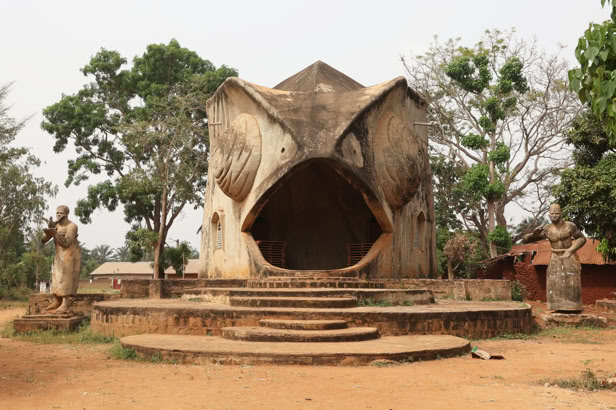
Further on we stopped by a voodoo temple, which featured ornate reliefs on the walls and two sculptures of animal heads, one of a jaguar, the other of a chameleon. The heads were big enough for humans to step into. A number of children were excited by our visit and ran around us.
At our lunch stop, I was pleased to find several stalls nearby selling the brightly coloured fabric which so many people were wearing. To our amusement, the fabric was printed in the Netherlands and shipped over to Benin. I bought two rolls.
Afterwards, our local guide took us to his home where we met his family. He’d bought various supplies during our travels, and his three children helped him unload those from the van.
We visited the nearby market, which included a number of stalls selling fetishes. No photography allowed. For use in voodoo rituals, one could buy monkey and reptile skulls, dried out bodies of various birds, snakes, hedgehogs, and bats. The smell was a bit thick, not entirely disgusting but I was glad to leave the area.
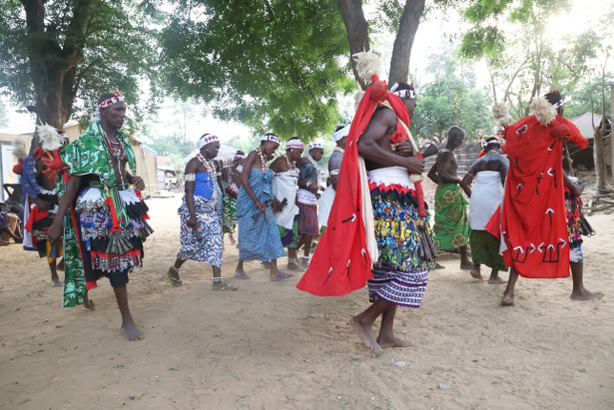
On to a village for a ‘Ceremony of Love’. Drummers set the beat, many villagers danced near them. A number of people had daubed white power over their faces and bodies. As we saw the previous evening, they were trying to go into a trance. Several did, and each time there were others ready to keep both them and others safe. One man in particular had a splendid skirt, and he twirled and leapt.
As we prepared to leave, some wanted to have their photos taken with us. Fair enough, as we’d been taken photos of them. We climbed into our van, sweaty due to the high humidity rather than any vigorous activity on our part.
At our hotel, we pre-ordered our dinner for the restaurant, setting a time for 7.15pm to meet and eat. We were offered some snacks and free samplings of a local spirit, made from fermented date oil. Our meals didn’t arrive until 8.45pm, which annoyed me more than other more relaxed members of our party. ‘African time,’ I was reminded. When it did come, the steak was very overcooked (like rubber). I ate part of it and concentrated on finishing my vegetables.
18 January
We were due to have breakfast at 7am for a 7.30am departure. One of our group was unable to enter his room, and the hotel had to send a handyman to sort the problem. Our local guide brought us croissants and yogurt to supplement the usual omelette.
At 7.50am we left the hotel. We drove down a rough track road to reach a village where a koku ceremony was held for us. Koku is a powerful warrior and this protective spirit is associated with strength and courage.
The usual drumming and singing encouraged dancers covered in white powder and yellow paste (made from palm oil). The dancers twirled, and at times drew knives across their arms and chests. We jumped when one man fired a rifle into the air. Several dancers went into trances, and at one point we had to hurriedly get out of the way of one of them. As before, others helped those in a trance, watching them carefully. Goats wandered up and tried to eat the yellow paste, only to be driven away.
Afterwards we followed the dancers into the village. Several of them appeared to still be in trances, and the helpers poured water on their heads, rubbed their faces, and blew into their ears.
We drove on to another village, where we wandered around and met people, taking photos along the way. Interestingly, unlike in the north, here we were not asked for water or money. We followed the noise of singing and drumming and found the local church was holding their Sunday service. People were dancing near the front, with a man singing loudly into a microphone. We were welcomed inside and no one seemed to mind as we took photos.
We went back to the hotel for lunch. Our guide summoned us when the food was ready. We then had a short break in our rooms, enjoying the air conditioning before heading back out into the heat and humidity at 3pm.
We drove to another village where the people were preparing for a dance ritual. The shamans were dressed in elaborate costumes which included wide shoulder pieces. We took photos of the male and female dancers, several of which had doll twins tucked into their clothing.
The dancers set off singing and dancing to the area in which the performance was to take place. We followed in the van, encouraged not to walk in view of the temperature. Several women from the village hitched a lift with us.
At the next village, we arrived before the dancers. I needed to find a bush, and when I emerged the rest of the group had gone into one of the buildings. I was about to follow, when the dancers arrived. I took a photo of them encircling a very odd structure. The platform held a couple of coffins and various personal items, including an old TV set. We were told that this marked the graves of two men found guilty of a crime. They had been executed, their bodies laid into the coffins, and their personal possessions piled around them. After their bodies had rotted away, the bones were removed to be used in temple rituals.
When I took off my shoes and joined the others, I found them in conversation with the local chief. I was told later that all of them had had to kneel and bow before him, touching their foreheads to the ground. I have to admit that I’m glad I missed that part. The chief’s brother interpreted for us.
Afterwards, we were invited to go outside and take seats. Warm beer was served, Budweiser in cans. I drank a small amount in honour of their hospitality, but left most of beer behind.
There was a lull as we waited for the dancers to finish whatever they were doing in the temple. They came out singing and dancing, in step with the drumming. Soon after they started, chairs were brought out so we could have a seat in the shade to watch the proceedings. The sun was beginning to lower in the sky, making the lighting a more difficult. People came up to pay homage to the chief, kneeling down to kiss the ground and rising with dirt on their foreheads.
When all of the various pairings had had their chance, the dancers went back to the temple. We took a few more photos before climbing back into the van. We didn’t have any women with us, but two of the larger drums were put into the back and we returned those to the first village.
At our hotel, dinner actually arrived at the time specified, 7pm. I had fish with vegetables, both tasty, although the fish had many small bones to contend with.
19 January
Another good night’s sleep thanks to air conditioning, which was almost too strong. We had breakfast at 7am and a delayed departure at 8am.
Our first performance was a surprise. What I call ‘the tall guys’ appeared, the tall, thin, fabric structures several times the height of a human which we’d seen at a distance at King Agassa’s house and at the Vodun Festival. We had comfortable seats in the shade as several of them danced and twirled. The smallest one, around the height of a human, acted naughtily. He zoomed up to the singers, jumped on to the tables in front of our chairs, and ran off several times. Each of the ‘tall guys’ had a guardian, who also made sure they didn’t bump into things.
We then drove to a temple dedicated to twins. As I’ve mentioned earlier, Benin women have more twins than the world wide average. If one or both of the twins dies, a small doll is made to represent the dead child. A family member carries the doll or dolls, and they are treated as if alive. The dolls go to events such as weddings, and have their own beds.
The area at the temple was rather compact, and we did get in each other’s way more than usual. We photographed the women with the dolls before heading back to the entrance corridor. There the twin ceremony took place, and our local guide, himself one of twins, also took part. The area was prepared with palm oil and alcohol so strong that the smell filled the area. Two chickens were brought and their throats were slit in front of us. Their blood was added to what had been already been daubed with the palm oil and alcohol. The chickens, still alive, were flung to the ground, where they flopped for several minutes before dying. I wanted very much to do something to put them out of their misery, but didn’t know what or how that would be received.
Afterwards we took portrait shots of the women with the dolls before heading off. The heat and humidity were even more stifling in the close quarters.
Lunch was a very nice one in Ouidah. We did some shopping in the places nearby which sold Benin souvenirs such as masks, bronze animals, and paintings.
We visited the Python Temple. In the car park, we were presented with two boys who were born blind. As far as I could ascertain, even as a previous group had funded the medical treatment for a boy’s legs, the hope was that we would be moved to offer money to help them. One of our group, a retired doctor, pointed out that the boys first needed a diagnosis as to what had caused their blindness. It could be that there was nothing which could be done to give them sight, as perhaps part of their eyes (for example retinas) was missing. There was no point anyone contributing money until it was known whether anything could be done. The meeting left me wondering whether this sort of approach to groups was going to be a feature of visiting Benin.
The Python Temple was very touristy and under reconstruction. We weren’t able to visit much due to the building works, but we did take turns in having a python draped around our necks. We’d thought that the pythons, which are revered, would be slithering around the area, but they were confined to a small hut. Nor do they roam the town streets at night, as they used to, due to the increase in traffic.
Continuing on the tourist trail, we went to the Gate of No Return. This was built to commemorate the slave trade. Rather cleverly, the side you see when facing the sea shows the backs of slaves heading towards a ship. The front of the gate, looking at the town, shows the slaves face on with a palm tree behind them.
We drove to a temple area for a performance of sakpata, at which we were the only observers. The four dancers twirled and leapt through the air, several also doing backflips. We were amazed both at their agility and their stamina in the wet heat. Afterwards, we were given permission by the local voodoo priest to take photos of the temple area.
Dinner was in effect like a takeaway, delivered to the hotel. I had the chicken, which proved to be very tough. The fish seemed to meet with better approval, although again those eating it found removing the bones difficult in the low lighting.
20 January
Another 7.30am departure. We returned to the village of last evening’s ceremony, taking seats outside the temple. The dancers were the same, but this time dressed in red for a ‘fire ceremony.’ After some energetic dancing, an intricate headset was brought forward. Pots filled with wood surrounded the head cap, and these were doused in alcohol and set on fire. One man then carried this on his head, even running around the area as smoke billowed out behind him. We left our chairs both for safety reasons and to take photos. It was a thrilling end to our time viewing various rituals.
We drove to Cotonou, where we braved the heat and humidity to walk through a local market. Our local guide took us to an upper level, where we were permitted to photograph the wares at a fetish stall. The heads and bodies of animals were similar to what we’d seen before, this time augmented by two pots of chameleons.
After we’d walked back down, our local guide decided it was far too hot to walk back to our van. He hired two tuk tuks, and we had a fun ride between the market and the river, and on the main road.
Lunch was at a restaurant offering traditional African food. I had chicken yet again, although this time the meat was moist and it had been cooked in a nice sauce.
A nearly 1km wall near the port had been turned into a graffiti mural a few years ago. We walked past, admiring the work of over 40 artists. We also made a brief visit to the Amazon Momument, a 30m high statue honoring the Dahomey Amazons.
Then we headed off to our hotel. Each of us had a room, which was handy for me as my flight was scheduled for 1.20am the next day. Soon after we arrived, a thunderstorm blew through, thunder and lightning accompanied by heavy rain.
I took a shower and packed for the flight home. Our last meal was at a beachside restaurant, where I had lovely steak and sautéed vegetables. We said our goodbyes at the hotel.
21 January
Immigration on leaving Benin took nearly as long as entering. But there was plenty to time to catch the flight to Paris. All of the snow from a fortnight ago had melted, although the temperature in England, just above freezing, was a bit of a shock after the heat of Benin!




























If you’ve enjoyed reading my travel accounts, you might enjoy reading my books! The first novel in my ‘Penny White’ fantasy series is only 99p for Kindle, free on Kindle Unlimited, and also available in paperback. Click on the image below to be taken to Amazon to buy your copy. My author website can be accessed by clicking here.