Travelling Hopefully
15 August
Although the flight to Madrid wasn’t until 5.30pm, for a change I was flying from Gatwick rather than Heathrow. So I started out at 9am (friendly neighbour giving me a lift to the train station), using the underground to get from Euston Station to Victoria, where I caught a train to Gatwick airport. I arrived too early to check in, so I had lunch with my luggage (not the best of companions, it mostly sat and sulked). I was able to drop off my bag afterwards, to be told at the counter that I had to fill out a questionnaire on-line to enter Bolivia. None of my research had told me this, but fortunately it was relatively painless and I screenshotted the QR code.
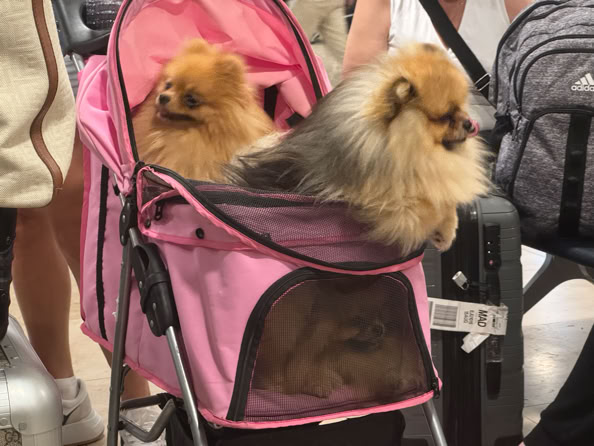
In Madrid I met up with Sonja, my travelling companion. We had differing experiences of the airport. She had to go through passport control and I did not, however I had to go through security and she didn’t. As we waited to board our flight, we were amused by three dogs in a carrier.
The flight to Santa Cruz was just over eleven hours long. I was using an airline new to me, EuropeAir, which did seem to be doing its best to wrangle every last penny out of a person. Seats were pre-assigned, and if you didn’t like them you had to pay to be moved. I paid extra for my evening meal (which was rather edible), particularly as this gave me a better breakfast, namely a cheese and ham croissant, an apple, and a yoghurt. Those who hadn’t paid extra were given just a muffin for breakfast.
16 August
We landed 5am Bolivian time. At immigration I was asked details about my holiday (Sonja wasn’t!) before my passport was stamped. The luggage collection was a bit chaotic, with handlers removing luggage from the carousel and placing them into various areas nearby so you didn’t know where to look for your case. But case arrived safely. Then it was through customs, the QR code checked and everything going through scanners one more time.
Our guide collected us and we were taken to a hotel where we paid for breakfast and waited for a final two people to arrive. The group consisted of nine people, two men, seven women, only one couple, the rest of us travelling solo.
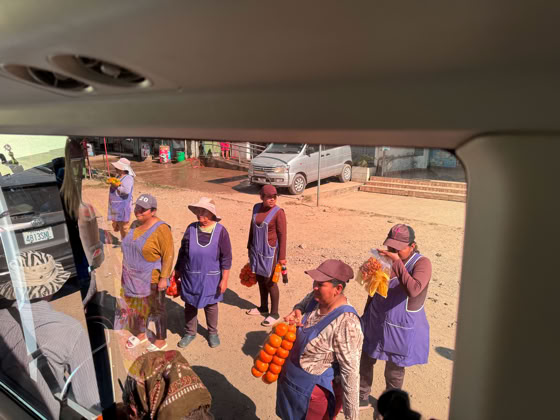
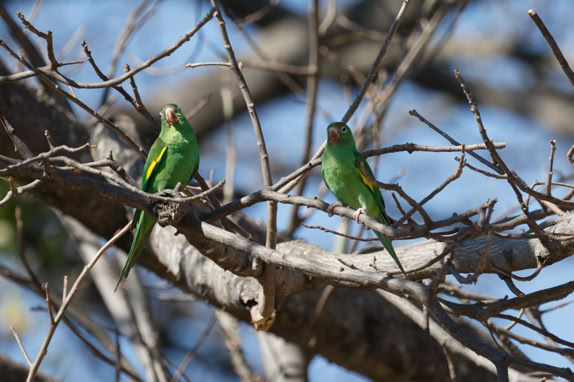
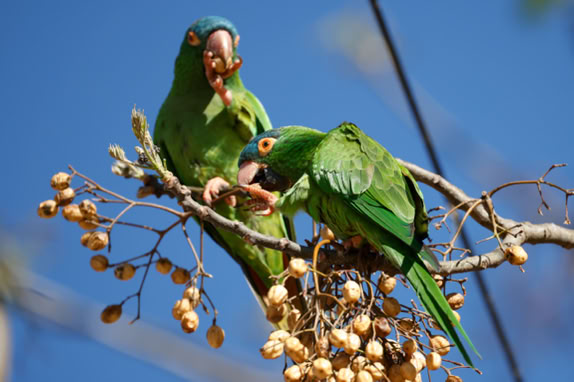
We left Santa Cruz for a three hour drive to our first destination, Samaipata. We stopped for comfort break, at which point our bus was surrounded by people wanting to sell us food products. I was thrilled to see a number of parrots in the nearby trees. Any day that starts with parrots is a good day.
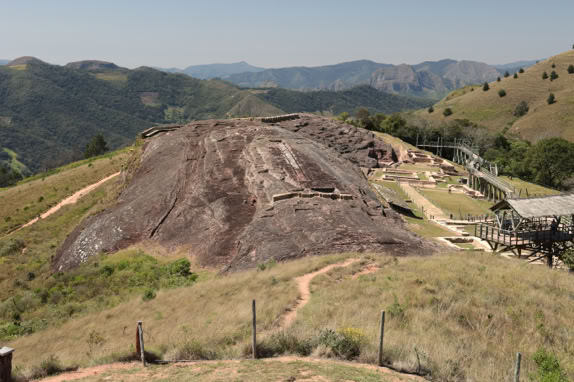
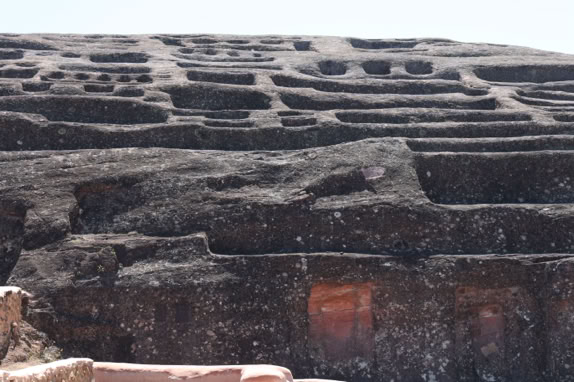
Nearby the town of Samaipata is El Fuerte de Samaipata. This is a pre-Columbian structure, high in the hills. We climbed up, a stiff breeze keeping us cool in the sunshine. Our guide pointed out that in one direction we had rainforest, in the other the drier Andes.
The site had viewing platforms overlooking the main feature, namely a giant stone slab, over 330 feet/100 metres long, covered in Inca and pre-Inca carvings of various shapes and animal designs. The setting on the top of the hill was splendid. Inca and then Spanish had built further structures near the carved rock.
We had the option of a short or a long return back to the car park. There seemed to be a willingness for the short, but when we moved off everyone turned for the long return. This led through forest and closer views of remains of other structures. The guide showed us where young girls would be raised, separated from their family, to be married off or sometimes used for human sacrifices.
Back in Samaipata town we had to search for a restaurant that was open. Due to the elections due to take place the next day, many places were shut. I tried order a local beer to go with my pork cutlet, but no alcohol was being sold during the weekend of the elections.
While other members of the group visited the local museum, I was thrilled to see and to photograph more parrots. They noisily commented on the seeds they were eating in the nearby trees. Two good parrot sightings in one day!
We also stopped at a hummingbird sanctuary. A local family, concerned about the dropping numbers of hummingbirds, planted a series of gardens with flowers to attract the small birds. The woman who owned the property explained that the main threat to hummingbirds were domestic cats. I tried and mostly failed to photograph the fast moving creatures. As ever, their iridescent colours were stunning in the sunlight. We saw at least four different species.
Our hotel was in town. More like holiday cabins, really, with bedrooms leading off from a kitchen and seating area. We met up for a trip briefing before going back to our rooms. I forced myself to stay up until 9pm.
17 August
I rose at 6.30am and successfully made a couple of cups of coffee. Breakfast was at 8am, consisting of a fruit salad, cereal, toast, and eggs. Only powdered coffee available, so I had tea.
At 9am we set off for town, walking down from the hotel. Our guide set us free in the square whilst she went to the voting station. She couldn’t vote there, as one is required to do so back home. What she needed to do was to prove that she couldn’t vote. Voting is obligatory in Bolivia. One is given an official document to prove that you’ve voted (or been unable to do so because of being away from home). For three months after an election, the document must be produced to undertake financial transactions, for example.
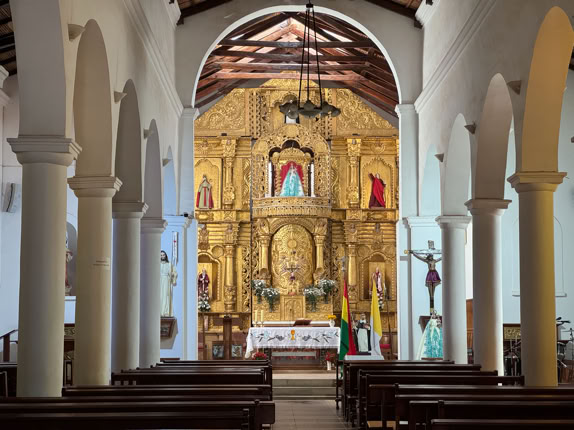
I wandered down some side streets and, when Mass had finished in the local church, I glanced inside. Our guide managed to do what was necessary and joined us.
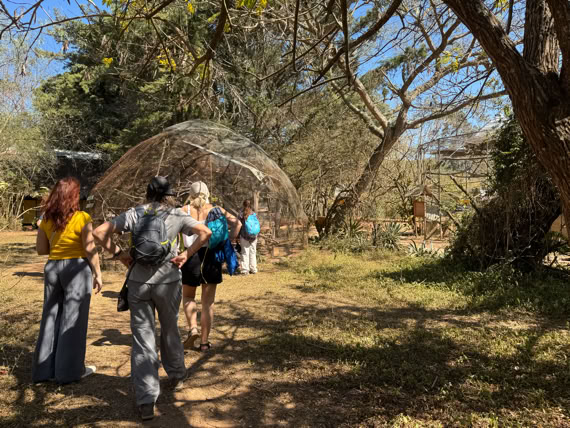
We headed out in the growing heat of the day to walk the 2 kilometres to a local animal sanctuary. I had decided to carry my usual camera equipment, something which I began to regret on the undulating gravel roads. I gradually became the straggler in the group.
The sanctuary was small, mostly birds in the various enclosures. I was pleased to see lots of fresh fruit and vegetables were offered to the parrots, and that they had plenty of branches and greenery. One enclosure held two green cheeked conures, the same species as my pet bird, Tilly. I’m convinced that one of them had been a pet, as he readily flew over to a branch near me. I did the head bobbing and sideways moves as I do with Tilly, and he mimicked my actions. Then he flew over to cling to the enclosure bars just inches away from me.
I decided to start back to town before the rest of the group, convinced that they would pass me part way. However, I arrived back ten minutes before they did, which surprised all of us.
We went for lunch at the same restaurant as yesterday, as again it was one of the few places open. I had steak with fried vegetables and rice. Again, one could not buy an alcoholic drink.
I ended up at the rear of the group, trudging up the steep road back to the hotel. Once there, I had a shower and washed a couple of shirts. Several people went with the guide to a local view point. I decided to stay behind, relaxing outside. Sonja advised me that the hotel shop was willing to sell alcohol, so I bought a couple of small beers. I had one in the afternoon and another in the evening.
18 August
An early rise as we had breakfast at 6.30am and departure 7.30am. A flock of conures decided to argue in a tree by the hotel, bickering over the flowers, but of course they decided to move on by the time I’d fetched my camera.
A 90 minute drive brought us to the entrance of the Amboro National Park. The only way up (and down) the steep unpaved roads was by 4 x 4 vehicles. Our luggage was transferred to a truck, and our group was split between the truck and a car. The drive took around 45 minutes, taking us through the jungle and down into the accommodation of Refugio de los Volcanes. Two women, whom I assumed were staff, travelled with us in the truck bed. I’m not certain I would have wanted to brave the roads like that.
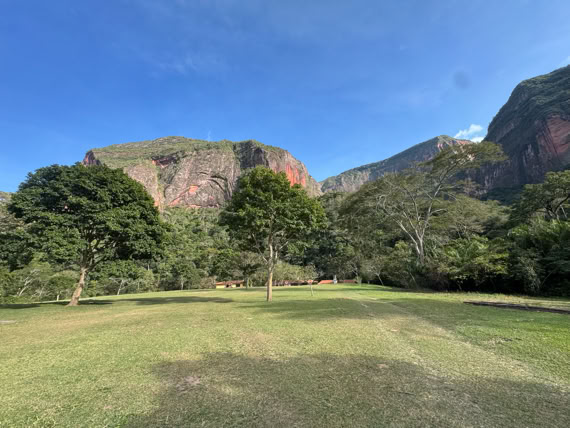
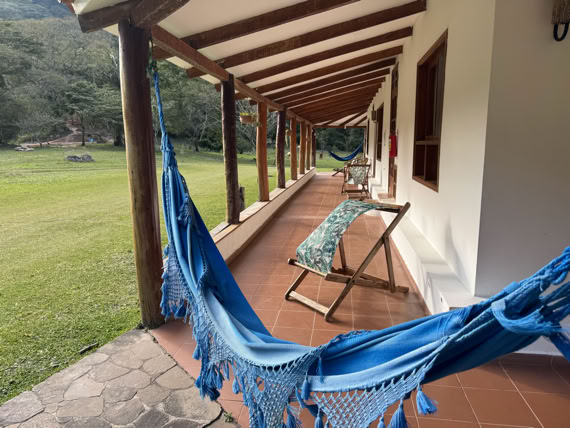
The setting for our accommodation was beautiful. We were surrounded by the rock-faced mountains, sections of red alternating with the grey. Horses wandered freely in the area. We were told that the two white horses (both geldings, from what I could see) were friendly, but we were to leave the other horses alone.
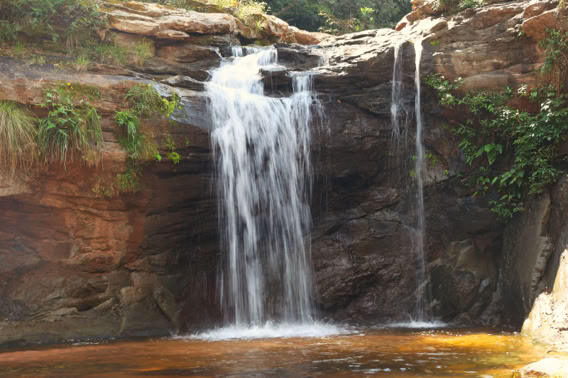
After checking in, we gathered for a walk to nearby waterfalls. A steep ladder led down to one, and slippery rocky steps to another. I had with me a monopod which doubles up as a walking stick. I had hoped to do some waterfall photography, but the others took just a few minutes to have a look before heading on to the next one.
When an option for a hike to a third waterfall was offered, I asked if I could instead spend a bit more time with the waterfalls we were already encountering. I must admit, I was also finding it rather warm and the going rather challenging. One of the local guides was tasked to stay with me, and I did my best with monopod to capture several of the waterfalls.
I returned to the accommodation, and waited for the others to return. Lunch was a buffet with many different salads and roast chicken.
Five of our group (out of nine) went on the afternoon hike. I stayed behind, hoping that birds might decide to call. I heard macaws and conures (or parakeets, as ornithologists call them, conure being the term used in the pet trade).
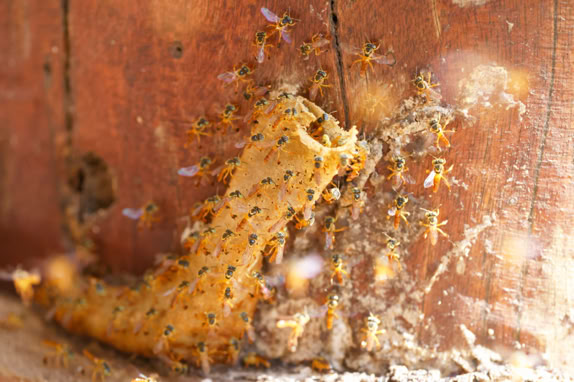
There was a steady breeze, but every so often a huge gust of wind would sweep down, rattling the buildings and kicking up dust. I was also fascinated by a group of insects, which I believe might have been winged termites. I took photos (at a cautious distance) of the structure which they seemed to be building.
Sonja and I went down to dinner early, buying a drink from the restaurant. Dinner was again a buffet, with various salads and stir fried beef.
19 August
A lazy morning. Breakfast buffet with fruit, bread, and scrambled eggs. I sat outside with cameras hoping birds might find a reason to visit. The winds continued to gust, which of course discouraged flight. I did see a flock of what I’m certain were green cheeked conures as the sounds and colours were right. They flew past trees so photography was pointless.
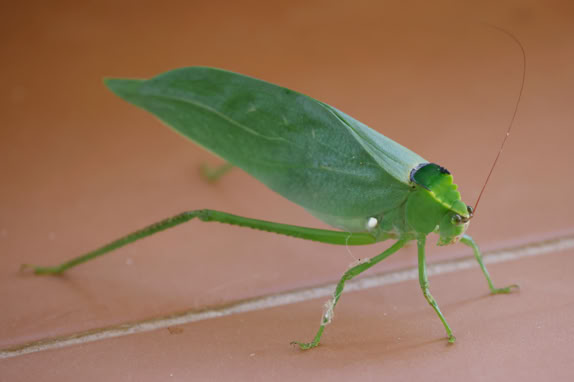
At one point I discovered a large insect hiding from the wind on the path around the rooms. When gusts threw leaves past (and were strong enough to move deck chairs) I worried for his safety. It took a bit of persuading, but I managed to get him on to a large leaf and I moved him to a nearby boulder. He glared at me for a moment before climbing to the other side, out of the wind.
At 11am our bags were loaded on to the truck and we headed on the bumpy road back to the main road and our bus. We passed the small coffee plantation which has been set up in the forest. A two and a half hour drive in the bus brought us to the airport, where we checked in. The weight limit for internal flights was 20kg, but my bag was only 18kg so no worries. I did have extra stuff in my carry on, which I’ll transfer to main bag at the next flight.
We had lunch at the airport and then waited to board our 4.25pm flight. The flight time was only 30 minutes, scarcely enough time to get bored. We landed at Sucre, and felt the high altitude (2790 metres/9153 feet) as we exited the aircraft. Our bags arrived promptly and a large private bus took us to the city.
Dinner was at our own expense. Two members of the group had scouted out a restaurant which offered a ‘tasting menu’ and half of us went. We had three snacks and then six courses, all small portions but with interesting mixtures of flavours. Between each course we were served either a cocktail or wine. Waiters explained in Spanish, and one of our group translated, what we were eating and drinking.
Some sort of local festival seemed to be going on, as we passed a march (children carrying lanterns) on the way to the restaurant and a group was playing in the main square.
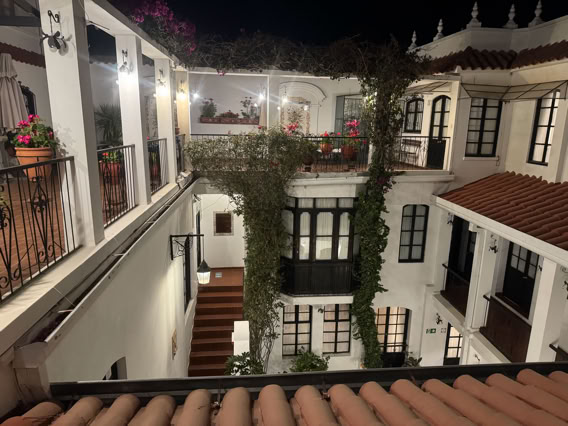
The hotel in which we were staying was lovely. Old fashioned furniture and decor, with the rooms off an open courtyard. Plants everywhere.
20 August
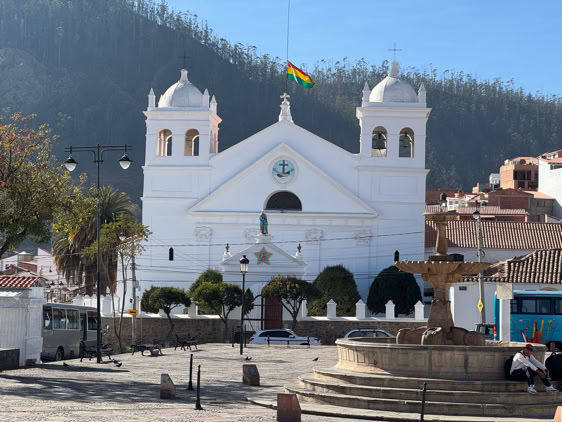
Filter coffee at breakfast along with the usual scrambled eggs, toast, muesli, and fruit. At 8.30am we headed out, boarding our bus to be taken up the steep hill to the La Recoleta Monastery. This was originally built by the Franciscans in 1600. We admired the views (and I was overjoyed in seeing a flock of parrots) before going into the building. A dog tried to follow us and a staff member told him gently but firmly that he’d have to stay outside.
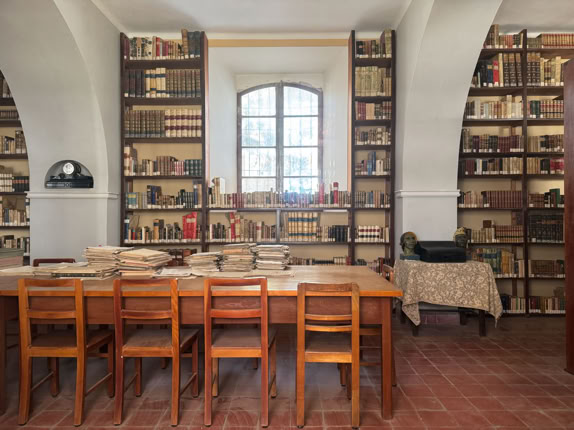
The monastery housed around two hundred priests and monks at its height. Now there are only eight. We admired the courtyards and peered into the cell of one of the founders and the nearby library. A tree which is thought to be over 1400 years old stands wide and tall near the vegetable gardens.
We viewed the church from the choir area, which was above the main body. I briefly tested the acoustics with a Taize chant after the others had left.
The museum was full of artwork and statues. Our guide explained that symbols of the indigenous people’s religions were hidden in the paintings of the Virgin with child, as the people could no longer openly practice their ancient beliefs. She also said that the many depictions of Jesus rather bloodied after being whipped were a protest by the indigenous population about how the Spaniards had treated them.
We walked down the steep street to the Museum of Indigenous Art. The woven tapestries were amazing, very detailed. Our guide showed us how the images reflected day to day life, such as ploughing, going to church on Palm Sunday, and working with animals. Sadly no photos were permitted. I would have liked to buy one, but the cost of even the smallest tapestry was £200.
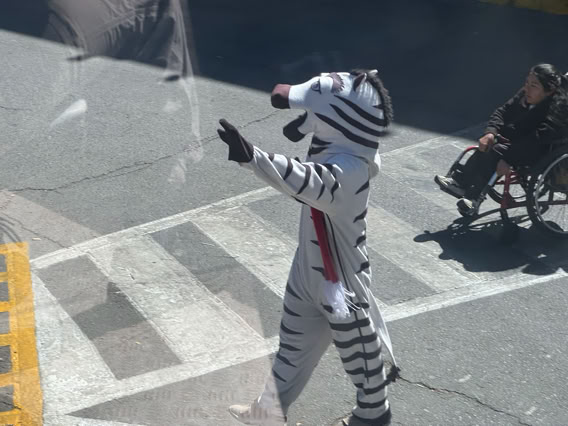
Returning to our bus, we were taken back to the main square. Much to our amusement, a man in a zebra costume was helping people to use a zebra crossing. And there were several marching bands, all in celebration of a local school.
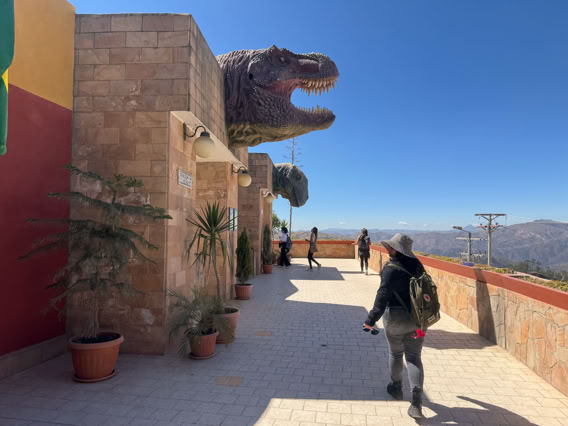
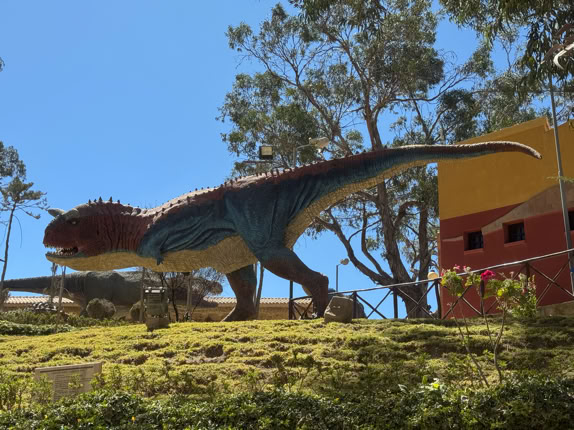
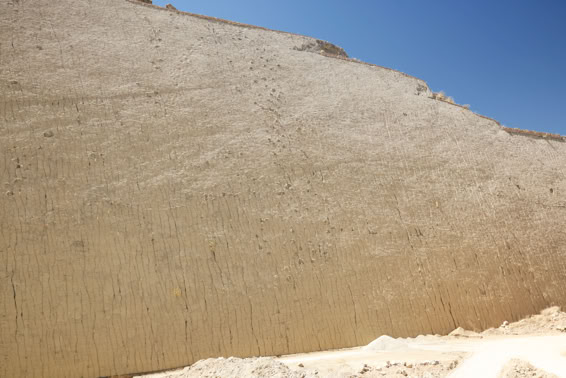
A local guide joined us as we boarded the ‘Dino Bus’ to the Parque Cretacico. Some years ago, a local cement company discovered that over 5000 dinosaur footprints had been preserved in the limestone. The dinosaurs had walked to a local lake, and due to the movement of tectonic plates the preserved footprints are now vertical rather than horizontal, on a long cliff front. The tracks of over fifteen dinosaur species have been identified, including a 347 metre trail left by a baby Tyrannosaurus Rex.
A dinosaur park has been built for visitors, offering full sized dinosaur statues of the local species We were led through this by an English speaking guide. We had to put on hard hats before venturing down the path to the quarry. We walked along the dusty gravel road to the face of the cliff, where the guide showed us the various prints. He also pointed out the work on a viewing platform, due to be completed over the next year or so. This will make the site more accessible, but I wonder if then people won’t be permitted to go up to the cliff itself.
I took my time climbing back up the steep path, very much feeling the high altitude. We had just enough time for a bit of food and souvenir shopping before taking the ‘Dino Bus’ back to the city.
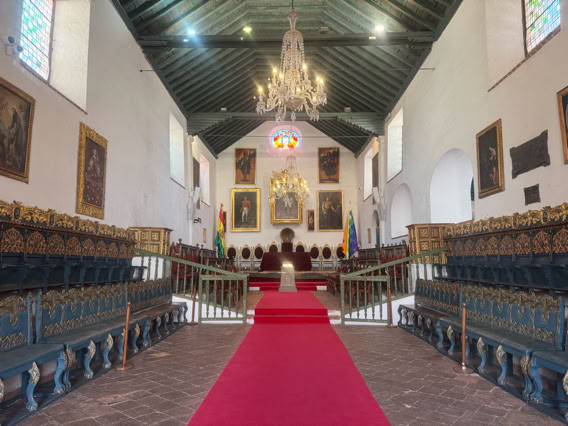
Our usual guide met us there. We visited the House of Liberty, which at various points in time has been a church and a school. It’s now a museum, and was where Simon Bolivar signed the Act of Independence in 1825. We visited various rooms off the courtyard.
The rest of the day was to be spent as we wished. Sonja and I searched in vain for a cafe. We ended buying a bag of popcorn and two cups of freshly squeezed orange juice from vendors near a square. We consumed our snacks sitting on a park bench.
Afterwards I returned to the hotel, and read in the lovely seating area with views of the courtyard.
21 August
A 7.30am departure, so luggage outside the door at 7am and a quick breakfast.
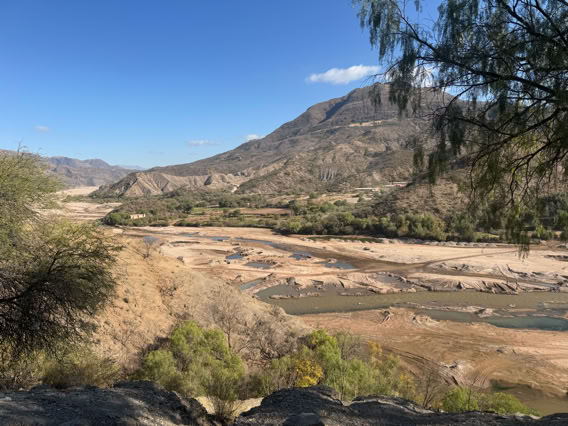
Our drive to Potosi took around four hours, with a couple of stops in the mountains to admire the views and to visit a bush. Our guide was insistent that we drank water regularly, due to the altitude, and so there was a natural consequence. At one stop we saw a man carrying firewood and a fox in the distance by the river. I was also pleased to see a flock of small parrots zoom past our bus.
We arrived at our hotel around noon. Staff carried our bags up the steep steps to our rooms, which I very much appreciated. We were now at 4,060 metres (13,320 feet) above sea level. I felt slightly light headed as we headed out to the town square.
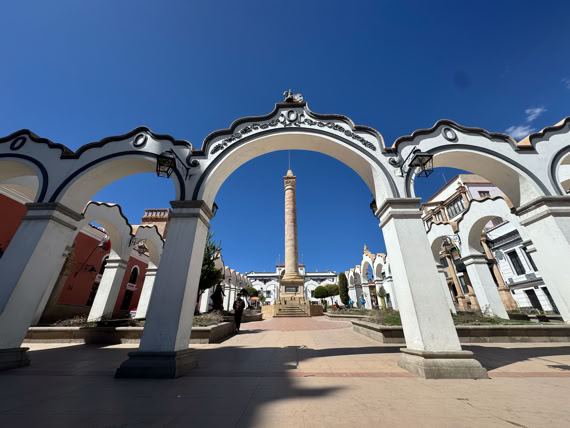
The square was busy with a celebration. Our guide showed us various buildings and pigeons took off in fright at the sound of gun shots. The square was beautiful, lined with grand buildings and various statues. We had a sandwich lunch in a cafe.
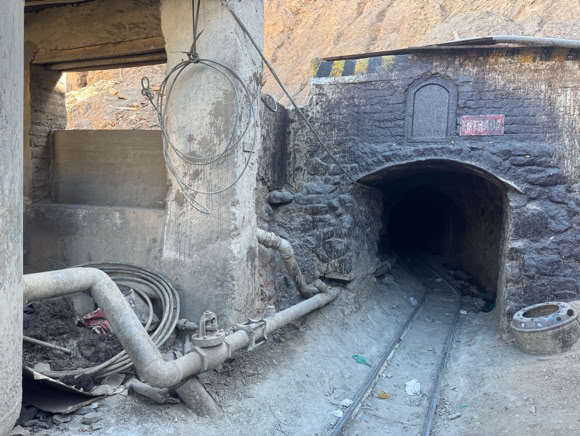
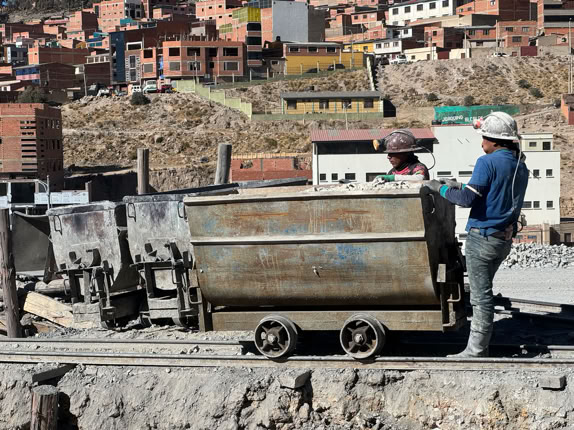
Five of us went on the tour to a local silver mine. A strange van like vehicle collected us. On board was a local guide, who explained that the silver mine was a co-operative. Families shared the work of mining, processing, and selling on the ore. The mixture of silver and tin is sent out of the country for refining.
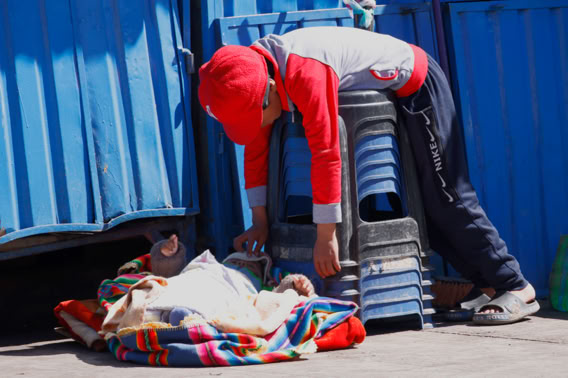
We visited the miners’ market, where coco leaves, pure alcohol, and explosives can be purchased. Other items were also for sale, and I watched a young lad playing with what I assumed was his baby brother.
Then we were taken to what the guide called ‘our office’. This appeared to be a living area, as washing was hung out to dry in the courtyard. We were given light coats and hard hats to wear. The guide also supplied us with face masks and bottles of water.
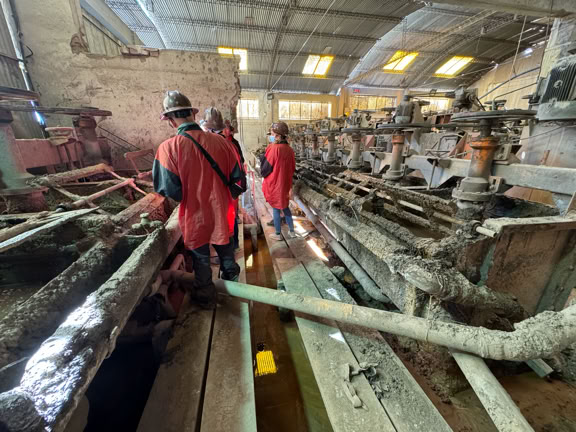
A short drive down the road brought us to the rock crushing plant. The guide showed us how hammers are still used to break down the rocks, and the machinery which grinds this even smaller. A problem with the machinery meant nothing was running, so no need for the masks (well, I didn’t wear mine, neither did the workers). We walked through the plant, including on some rather dodgy planks. All of the equipment looked very old.
Another drive, this time to the mine itself. We kept out of the way of the men hauling the carts. Our guide showed us the entrance, and explained that forty six llamas are sacrificed every year, the blood poured over the entrance to the mine as an offering to the earth goddess. The llamas are then eaten by the miners and their families.
Our last stop was at a viewpoint over the city. The wind was picking up as we made our way over the gravel refuse from the local mine.
The van dropped us back to the square, and we walked back to our hotel. I had paid for laundry to be done at our previous hotel, but some items had come back not fully dried, so I hung those up in the room. Couldn’t complain at the price though, around £1.50 for two shirts and a batch of underwear and socks.
Dinner was at a local restaurant. I had a burger and although I gazed longingly at the beers on offer, I stuck to water. Mixing alcohol with high altitude can lead, in my experience, to headaches.
22 August
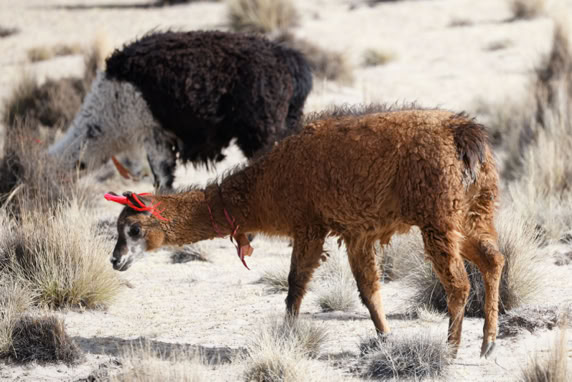
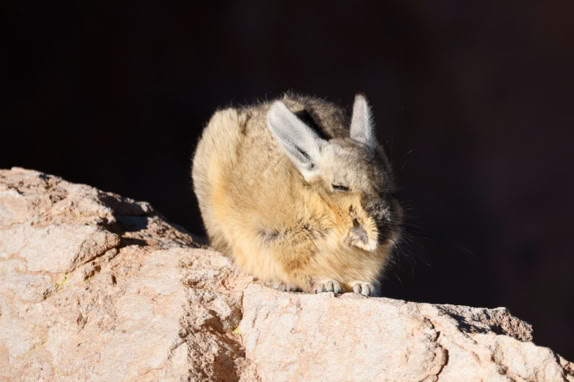
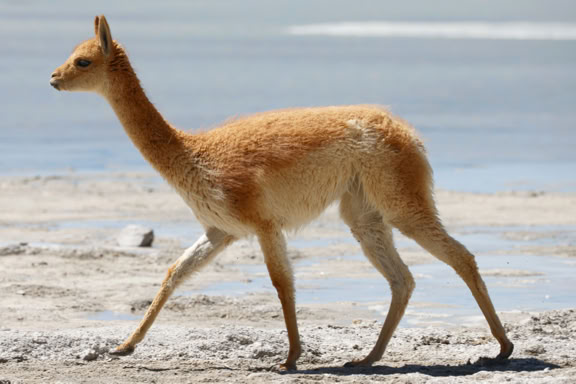
We left Potosi at 8am and headed out across the arid landscape towards the salt flats. The four hour drive was rather cold and windy. Stops were made for scenic views and so we could photograph llamas. Bushes were also visited as necessary. We also saw vicunas and lesser rhea.
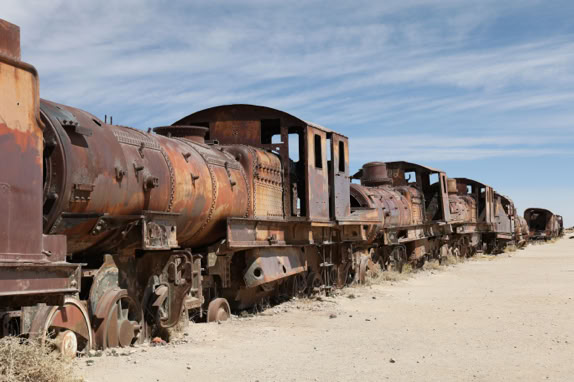
At the last large town before the wilderness we left our comfortable bus and split into three groups to fit into 4 x 4s. The somewhat battered cars took us down a mixture of paved and unpaved roads, heading further into the high altitude desert. The wind gave us occasional dust storms. I was thrilled to visit the locomotive cemetery. People climbed the ruins and used the swings which had been placed into a couple of locomotive frames.
One vehicle developed a fault. The three drivers were unable to fix it at the roadside, so we limped into San Cristobal. The town’s market had toilets, and we also visited some of the gift shops. Sonja and I purchased llama jerky which at the time of writing we have yet to sample.
Our belongings were transferred to a different 4 x 4, and we continued our journey. Our understanding was that the fourth vehicle was transporting the possessions of our drivers, including their sleeping bags, as they would be staying in much cheaper accommodation than ourselves, which might not provide heating.
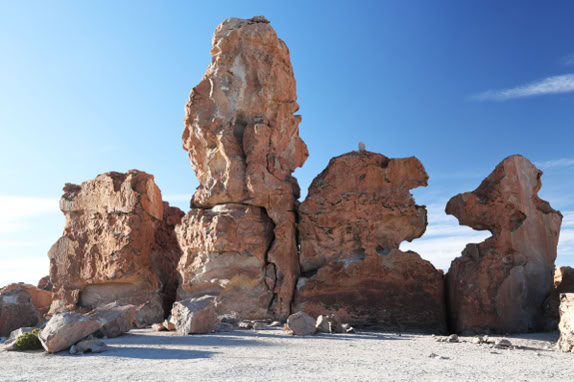
Our last stop was at a series of rock formations. A very large rabbit rested nearby, and allowed us to take a number of photos before dashing off.
We arrived at our hotel around 5.30pm. The building was set against a rock, and some of the rock face featured in common areas, as well as in the bedroom which Sonja and I shared. Although attractive, the room provided very little space for luggage.
Dinner was a buffet, offering a warming corn soup, beef, chicken, rice, and salad. Again I looked longingly at the beer on offer before yet again sticking to water. We were at a lower altitude than last night, but at 3,800 metres I decided to remain cautious and avoid alcohol.
23 August
An early rise, departure 7am. The temperature was cold, as forecast, and I had dithered over what to wear. In the end, assuming that we’d have heating in the car, I put on thick trousers but not long underwear. I had several layers for my top as well as hat and gloves.
The day was bright and sunny. What cut through us was the wind, gusting to such an extent that I was nearly knocked over at one point. And the driver never put heating on in the car, which meant little recovery from the wind chill factor.
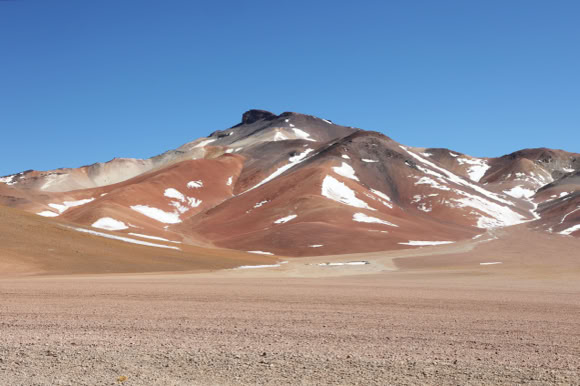
We bounced down gravel roads through wonderful landscapes. Some of the mountains bore a number of colours, reflecting the mineral make up. We passed snow and ice, and forded rivers which were partially frozen.
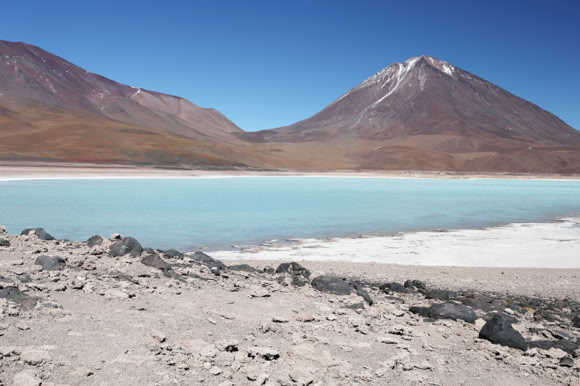
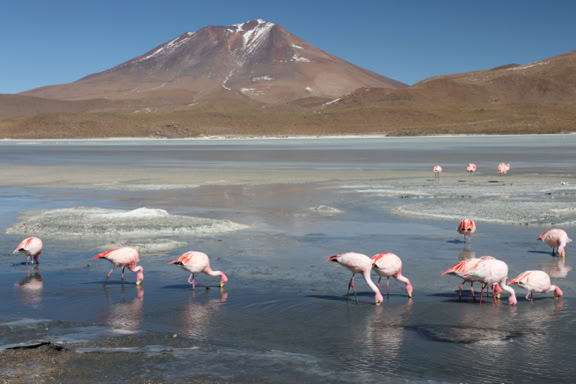
Our stops were short but interesting. We visited various lagoons, all named after a colour. In English, the White Lagoon, the Blue Lagoon, the Red Lagoon. Vicunas and llamas watched us pass by. Flamingoes frequented a number of the lagoons, as did gulls and ibis.
We enjoyed a nice lunch at one lagoon, sitting inside a cafe to eat chicken, vegetables, potatoes, pasta, avocado, and cheese. Several members of our group had a short soak in the natural thermal baths. I busied myself taking photos of vicuna and birds.
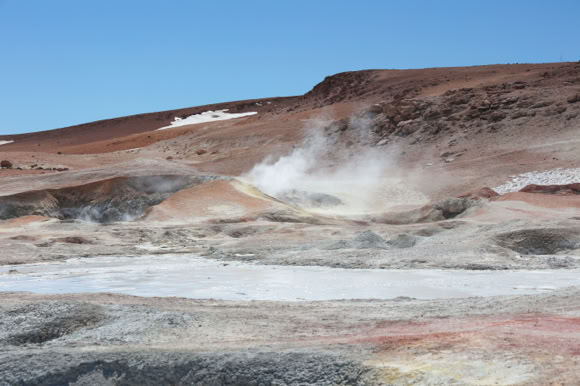
Our highest point of elevation during the day was 4,850 metres/15,910 feet, when we visited a geothermal area. Bubbles erupted in mud pools and steam emerged from the ground. The smell of sulphur filled the air.
The wind seemed harshest at the Red Lagoon. I found some shelter behind a sign to pull out cameras for photos. Others in the group went for a walk, but I’d had enough and I retreated to the car. The gusts were even shaking the vehicle.
The last stop was to view rocky formations, sculpted by the winds. We then had a two and a half hour drive back to the hotel, the last portion in the near dark. I became colder and colder in the car, putting on my hat and gloves and spreading a coat over my legs.
Dinner was again a buffet, this time a meat soup followed by spaghetti bolognaise. I drank several cups of herbal tea to help warm myself up.
24 August
A nosebleed in the night led to interrupted sleep. The high altitude and dry conditions had dried out my nostrils.
I put on multiple layers top and bottom. This meant for a more comfortable day, but more hassle at ‘bush stops’.
A discussion had broken out on the group WhatsApp. Our guide had mentioned the idea of visiting some rock art in the morning, which would have been an addition to the published itinerary. Several people in the group wanted an earlier end to the day, and wanted to not only avoid the time for seeing the rock art, but also asked to be taken to the hotel after lunch. After some discussion, it was decided to skip the rock art for all, and the four who wanted to go early to the hotel could do so in one car. The rest of us would continue with the afternoon programme.
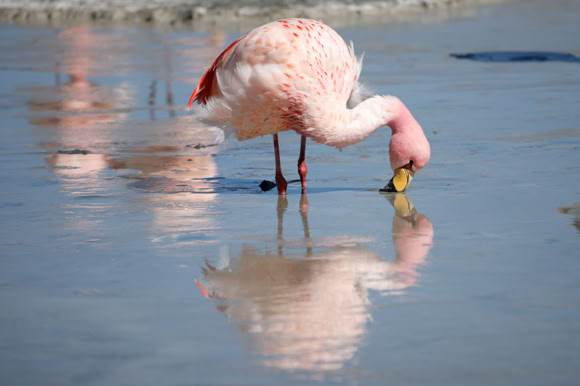
The wind was light in the morning. We visited more lagoons, and were thrilled to be in nearly touching distance of flamingoes at one site. I’d not put on my jacket, so my hands slowly froze as I photographed the pink birds. They cast reflections on the clear water.
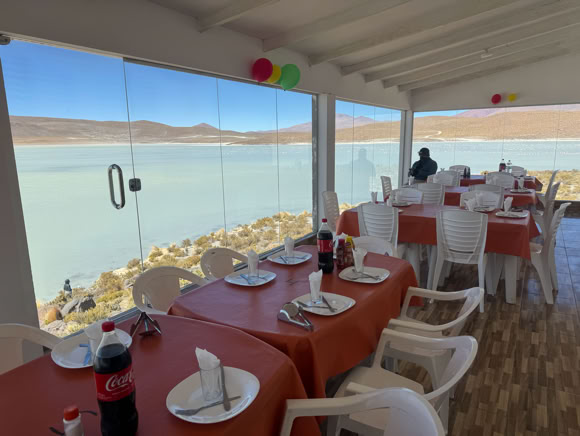
Lunch was in a cafe with windows overlooking the lagoon and mountains. We had similar to yesterday, namely breaded chicken, vegetables, avocado, cheese, and rice. I enjoyed an orange but then faced a lack of facilities to clean my hands. The toilets were a hill trudge away. I did make the journey before we departed.
The wind picked up during the day. We had a second nice flamingo encounter at another lagoon. As before, the sulphur smell was quite strong. We saw several juveniles, their feathers grey rather than pink.
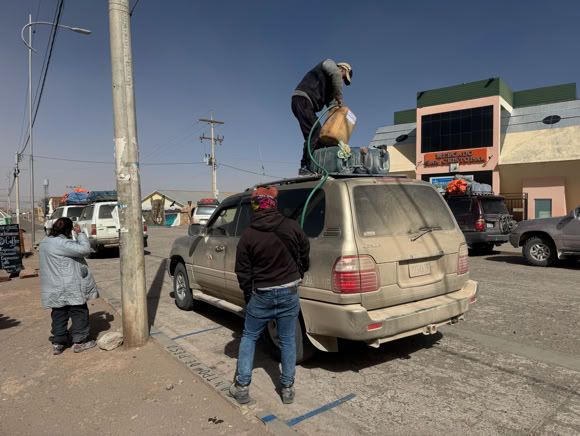
Afterwards we stopped at San Cristobal for a comfort break. The men decided to fill the cars with diesel (running a pipe from a container on the car roof to the fuel tank inlet). I discovered that a local coffee shop was open, and a number of us enjoyed freshly made drinks. And free wifi!
We headed off to our hotel. The wind had once again become quite strong, and we experienced a number of dust storms. A flat tyre on one vehicle meant a short stop whilst the drivers changed tyres.
Around 5.30pm we arrived at our very posh hotel, the Hotel Palacio de Sal. Much of the hotel is built out of salt bricks, including the ceilings in the bedrooms. We were given a welcome drink, a variation of a pisco sour. The room was large, with space for our luggage and a kettle. Dinner was a buffet, very good, and Sonja and I ordered a half bottle of Bolivian red wine of which we drank half, saving the rest for tomorrow.
25 August
A lazy morning. We didn’t leave the hotel until 10.45am (was supposed to be 10.30am, but the queue for diesel took longer than our drivers had anticipated). We headed out into the salt flats for the day.
Our first stop was to visit a display of salt harvesting. Our guide had us try the salt crystals, and she also showed us how the salt is refined. Iodine is added to the finished product. Salt was for sale as were other objects, including elephants sculptures made from salt. I failed to see the connection.
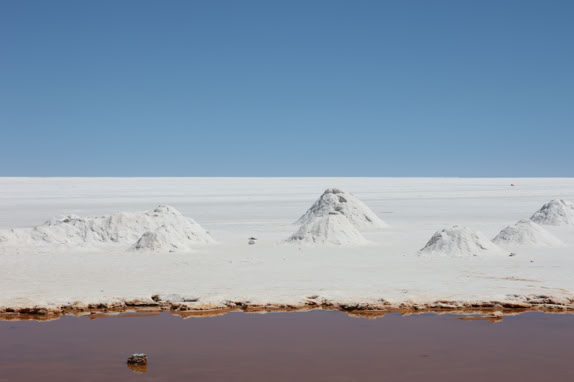
On the salt flats itself, I found myself wishing that I’d brought my clip on sunglasses to add to my regular sunglasses. The bright sunlight reflected off the white as if it were snow. The actual salt extraction area is off limits to tourists, but some of the traditional salt pyramids were on display. Water bubbled through cracks in the salt.
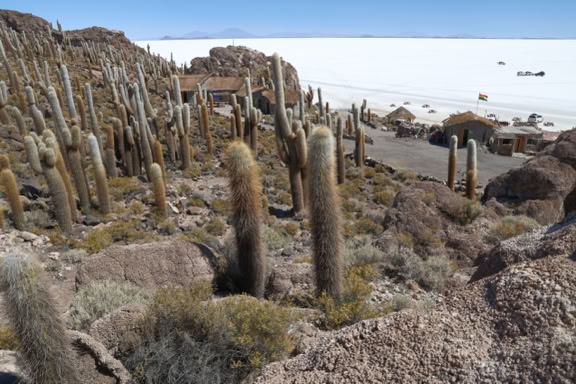
We drove on to Incahuasi Island, a rocky outcropping with large cacti. The rest of the group clambered to the top. I only went part way before I decided that the weight of my camera equipment was too much for the hike and the altitude. I went back down and amused myself by taking photos of the local finches flitting around the area.
Lunch was a picnic, seated on chairs put up by our drivers. Main course was llama, which to me tasted like beef. It was the birthday of one of our group, and he was given a small cake in celebration. Lighting the candle proved to be difficult in the windy conditions. Two finches flew over to look for scraps.
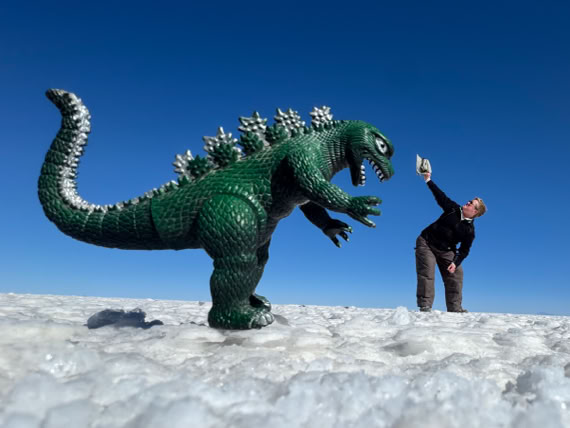
A drive to another area of the flats gave us the opportunity to make some fun photos, playing with forced perspective. We pretended to be attacked by Godzilla, drinking from a large bottle of wine, and posing on other’s hands. Our group also made some videos.
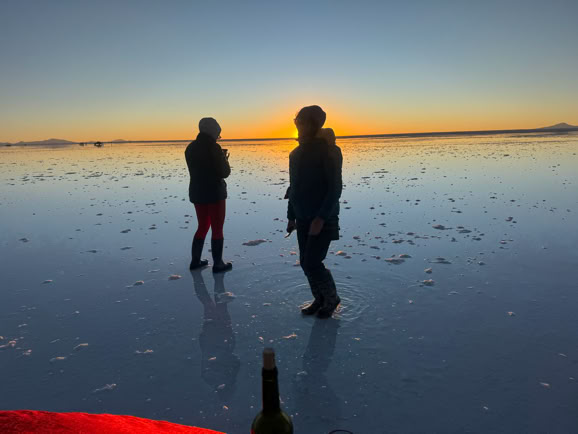
After collecting some Wellington boots, we drove to a section of the flats which had water. Now we played with the reflections, making more videos. As the sun went down, we were served wine and snacks.
We returned to the hotel in time for dinner and then Sonja and I relaxed in our room.
26 August
Another night of disturbed sleep. Although I didn’t have any nosebleeds, my nose keep clogging up, forcing me to do my best to blow it clear. Although I’m grateful not to have many symptoms of altitude sickness, for example the headaches from which I suffered in Bhutan, this nose issue is definitely most annoying.
We left at 7.30am for the 30 minute drive to the local airport. At 9.15am our plane left, taking us to La Paz in 45 minutes. To go overland would have taken around twelve hours.
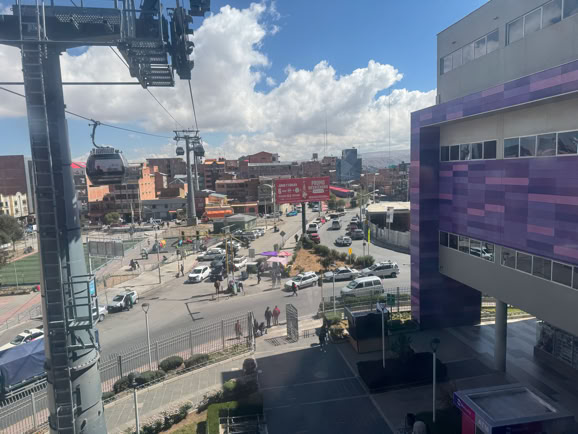
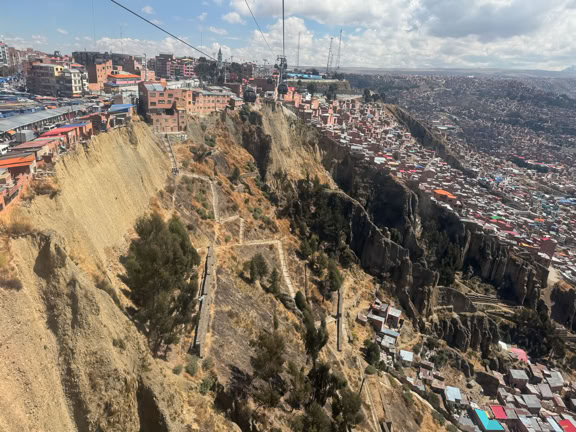
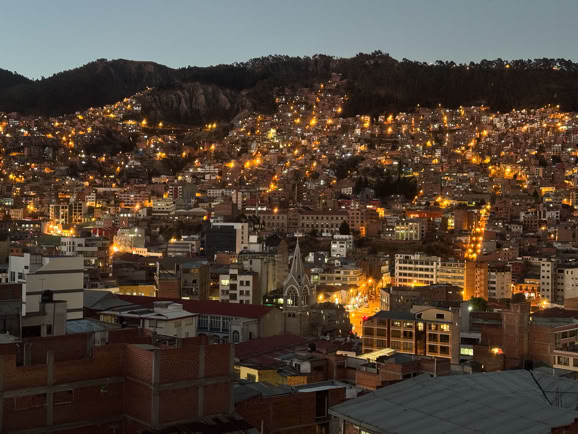
We were collected by a minivan and taken to a cable car station. Cable cars form part of the public transport network, taking people off the roads. We used a couple of lines to take us from the upper part of the city to the lower, admiring the views. The minivan collected us at the bottom and we dropped our luggage off at the hotel.
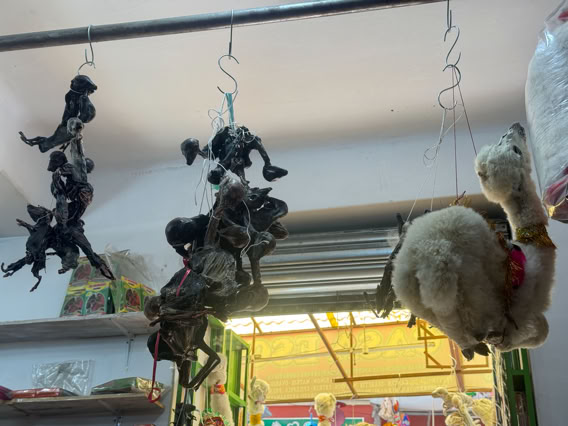
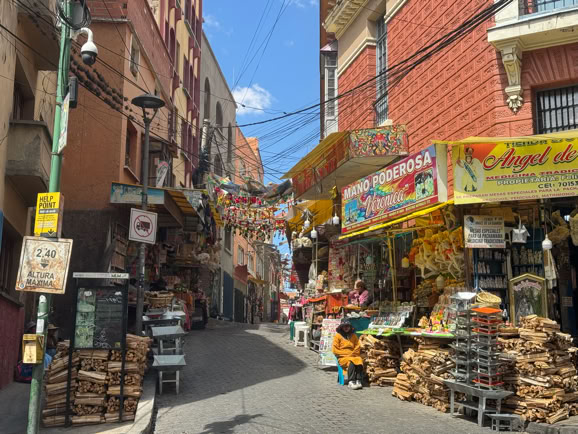
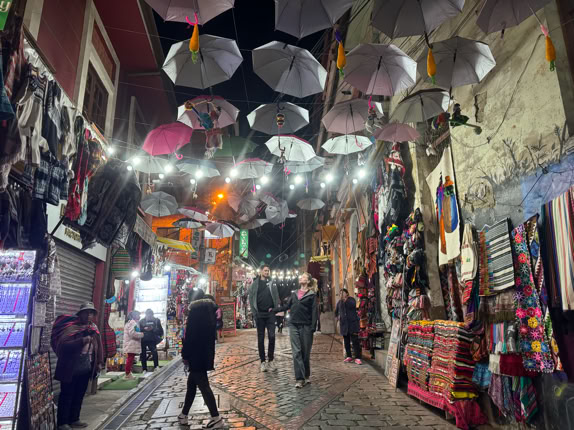
Our guide took us on a walking tour. We visited the Witches Market, in which dried llama foetuses are sold as well as other statues and amulets to bring good luck and fortune to one’s home. Traditional medicine was also on offer, with various concoctions available for ailments. And of course plenty of souvenirs.
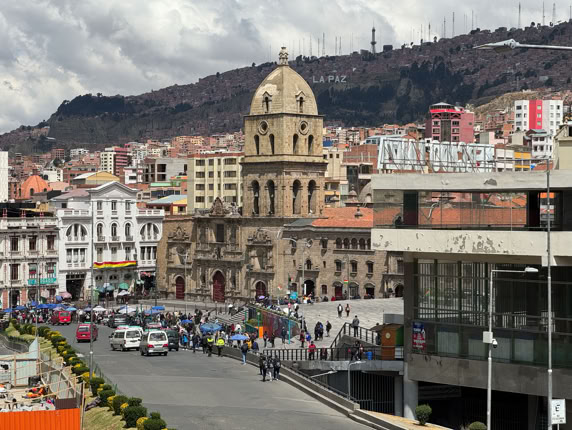
We passed the Basilica of San Francisco, built between 1743 and 1772. It’s kept shut during the day, so we admired the carvings and statues on the outside. Our guide took us on to Plaza Murillo, the central plaza of the city. We went inside the Cathedral, built in 1835 and dedicated to Our Lady of Peace. We also admired the Presidential Palace and the Congress building. Guards stood outside the latter.
Lunch was a tasting menu at a vegetarian restaurant. I went for the five course option, which consisted of small but tasty portions of various plants. Sourdough bread accompanied one dish, which surprised me, as I’ve always associated sourdough bread with the USA (California in particular, as the bread came from the Gold Rush). I also had a glass of Bolivian white wine, a muscadet which went very well with the food.
We returned to the hotel, which was a bit of a walking distance away. La Paz’s altitude is 3.650 metres/11,980 feet. I found myself struggling as we went steadily uphill, and I finally swallowed my pride and asked for a break. Not being able to breathe through my clogged nose didn’t help.
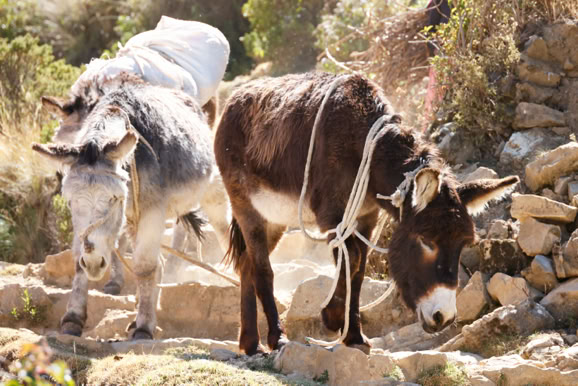
At our hotel, we collected our bags and our key cards. Our guide gave us small duffle bags. Tomorrow we have to hike to our hotel on Sun Island, Lake Titicaca, but donkeys have been hired to carry the duffle bags. We’re there for two nights. In the hotel room, I concentrated on my packing. I’d already decided I’d only take one camera and lens. With a bit of clever packing, I was able to put the camera backpack, other camera and lenses inside, into my main suitcase. Main cases would be left on our minivan during our time at Lake Titicaca.
After our big lunch, Sonja and I were happy just to have snacks for dinner. We went up to the small coffee bar at the top of the hotel. We sat on the terrace and admired the views of La Paz. After sunset, we ventured inside and enjoyed a cup of tea.
27 August
An 8am departure. We had a four and a half hour drive to Lake Titicaca, with a couple of comfort breaks (using facilities which had seen better days) on route.
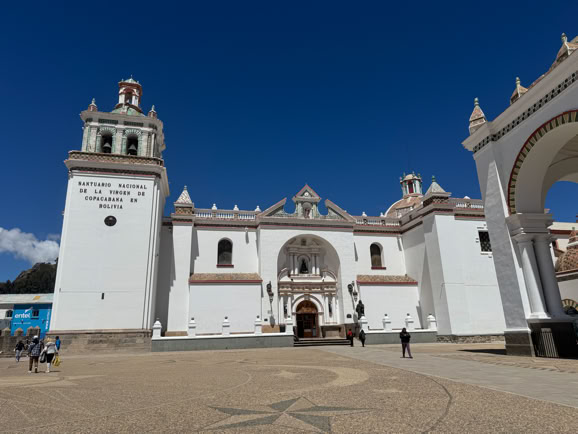
Once at the lake, we boarded a small boat chartered for just our party, whilst our van was taken on a separate barge. We reunited at the town on the other side, and continued our drive. Another hour brought us to Copacabana, a resort town. We had a short walk, admiring the Basilica of Our Lady of Copacabana, a 16th century Spanish colonial construction. Our Lady of Copacabana is the patron saint of Bolivia.
We boarded another boat, chartered just for us, for the hour long journey to the Isla de Sol (Island of the Sun). Archaeologists believe that people have lived on the island from as far back as the third millennium BCE. There are no paved roads nor motor vehicles on the island. The eight hundred families who live here farm, fish, and make some money from tourism.
Lunch was served after we arrived. We sat outside, slightly cold in the wind, and enjoyed chicken, local caught trout (the fish was introduced to Lake Titicaca in the 1930s, which has enabled a fishing industry but probably led to the extinction of least one native species), dehydrated potatoes, corn on the cob, and lima beans. Our duffel bags were loaded on to donkeys to be taken to our hotel.
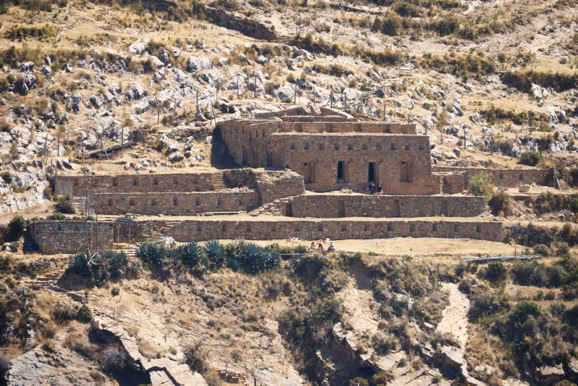
Our boat took us to Pillkukayna. We visited the Temple of the Sun, an Inca ruin, and were happy to see a large hummingbird flying nearby. There are over eighty Inca ruins on the island, most dating to around the 15th century BCE. Some Inca origin myths state that the island was the birthplace of the Sun God, or of his son, Manco Capac. We went inside the brick structure to admire the rooms.
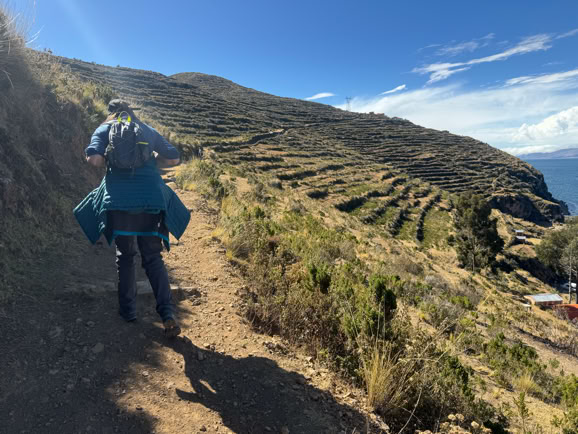
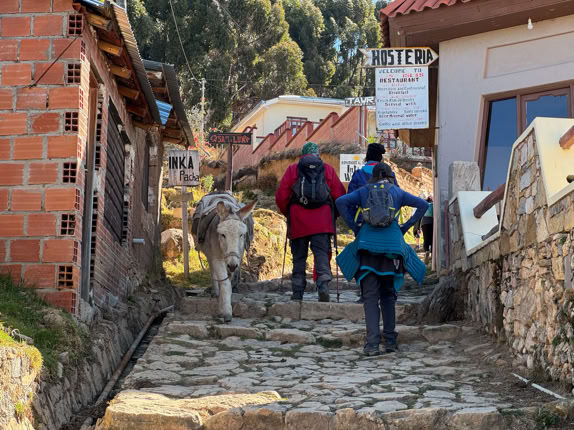
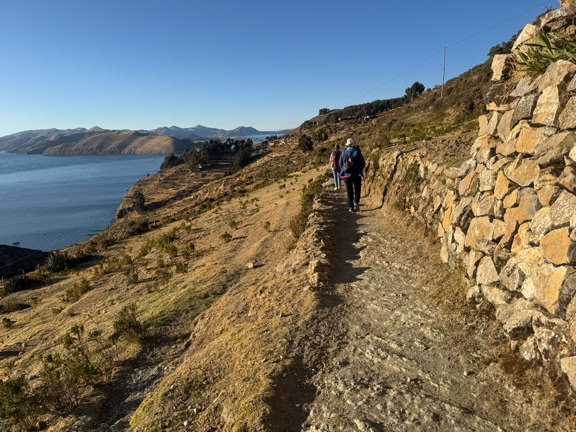
Then began the trudge up the hill to our hotel. Our guide had said we could take the short but steeper path, or the easier but longer one. A majority vote had gone for the supposedly easier path. I had hoped for a number of stops for site seeing or photography, but this wasn’t to be. The main group kept going, whereas I had to stop often for breathing breaks on the uphill stretches. The altitude was 3,800 metres/12.500 feet.
I went into ‘Operation Endurance’ and decided to ignore my ego and just take whatever time I needed. Every so often my heart would race, and that’s when I’d definitely take a break. I was glad that I only had the one camera and lens to carry, and my walking stick to aid me.
All around were Inca terraces, built for farming. Donkeys and children who made light of the high altitude passed me on the paths. Locals had set up wares for sale, and a couple of women had young alpacas alongside which they’d pose for a photograph in return for payment.
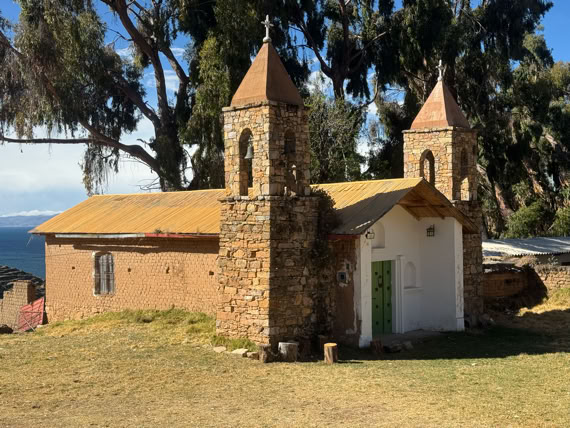
We walked through the town. The group had paused by the church, and I managed to take a quick photo before we set off again.
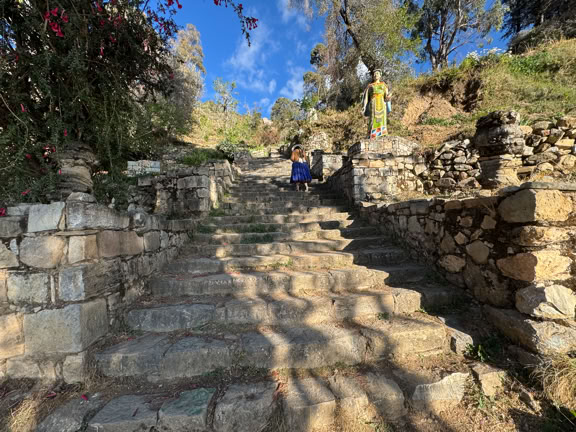
Every time I thought the trial would be over, there was yet another set of steps to climb. That these were of Inca construction did little to ease the breathlessness nor the growing ache in my calf muscles. ‘Operation Endurance’ I reminded myself.
Finally I reached the hotel. In the restaurant, tea was available. Both tea bags and a ‘mix your own’ were offered. The latter consisted of a number of dried herbs, in separately labelled baskets, which you could mix together before pouring hot water over the mixture. Mugs which had strainers were nearby.
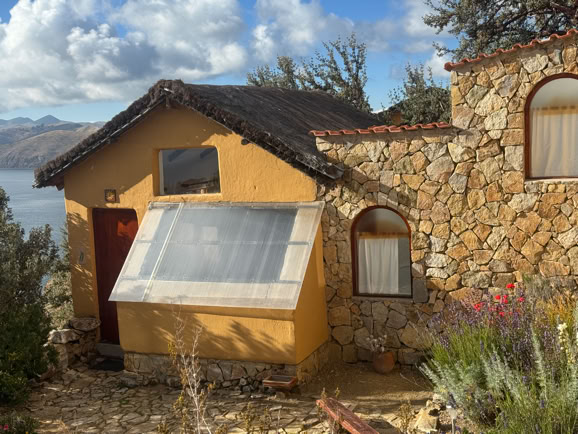
Our hotel cabin was down a flight of steps. One of the hotel staff took pity on me and carried down my duffel bag. Once in the room I groaned my way on to a bed, drank lots of water, and amused myself by catching up on emails (the hotel had good wifi).
Dinner was back up the two set of steps to the restaurant. Night had brought a chill, so we wore several layers. Starter was a vegetable soup. I’d chosen trout as my main course, and this proved to be very tasty, served with cauliflower and carrot cheese and potatoes. Dessert was poached apple slices in caramel. Hotel staff gave each of us a hot water bottle to take back to our rooms.
There was outdoor lighting for the first set of steps, but I had to use the torch function on my iPhone for the second set (I’d forgotten to pack a torch). Sonja and I put the lights out at 10pm.
28 August
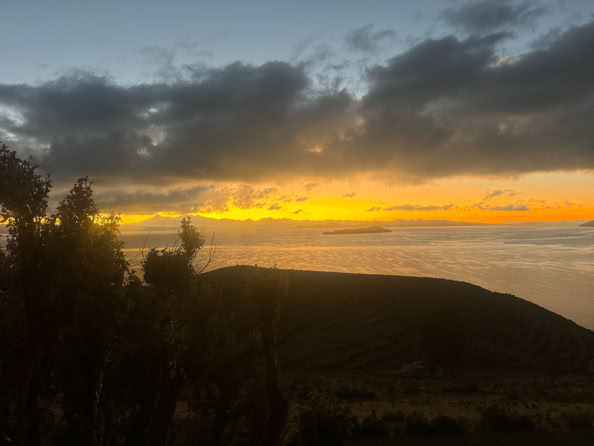
Slept pretty well, nose remaining unclogged until 6am. I took a photo of sunrise from the room’s windows. Breakfast offered fruit, bread, cereal, and eggs. Coffee came as a strong liquid to which you added water (I encountered this in Peru). Several women had set out wares for sale just outside the restaurant. I bought a cushion cover, giving the woman the two hundred Bolivian dollars she asked for (around twenty pounds). I’m certain I could have haggled for a lower price, but I felt she probably needed the money more than I did.
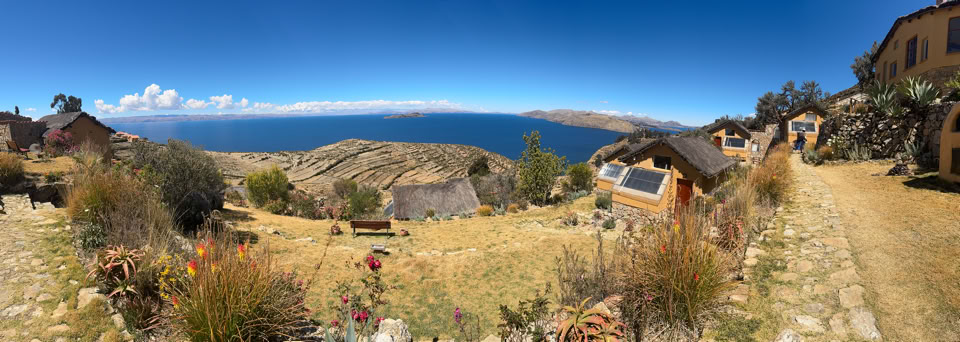
The itinerary for the day was a boat trip to visit Isla de la Luna, ‘Island of the Moon’. However, this meant walking down to the dock and, more importantly, going back up to the hotel again. Only three people in the group decided to make the trip. The rest of us chose to do other things. Several went for a walk to the town. I decided to work on this travel blog and do some reading. I also took a panoramic photo of the view from the hotel.
Lunch was a three course meal, vegetable soup followed by a chicken leg with rice and vegetables, finished off with fruit salad. I continued my reading and greeted Sonja upon her return in the afternoon.
Dinner was vegetable soup, followed by vegetarian spaghetti and then apple cake. I went to bed at 9pm, exhausted despite doing very little all day.
29 August
Another mostly good night’s sleep. I rose at 6am, pleased by a nose which had not clogged during the night. Sadly two of the group reported difficult nights, both finding themselves so breathless that they wondered about asking for supplementary oxygen.
We’d been told that our bags would be collected to be taken to the donkeys. At breakfast our guide expressed concern that we hadn’t already done so—but she hadn’t told us a time. We abandoned our table to quickly obey. One of our party asked how we were to be certain that our luggage had been collected, and we were assured that it would happen,
This time we took the short but steeper route down to the docks. Again I felt frustrated by the pace, both because I wanted to be cautious on the steep steps but also because I would have liked to take photographs. We halted briefly by the ‘Fountain of Youth’, which used to be the water source for the village. They now have pumped water.
After the quick journey down, we had to wait twenty minutes both for our boat to arrive as well as for our guide’s luggage. Her bag had not been collected. I recovered my breath and reminded myself that the last difficult part of the trip was over.
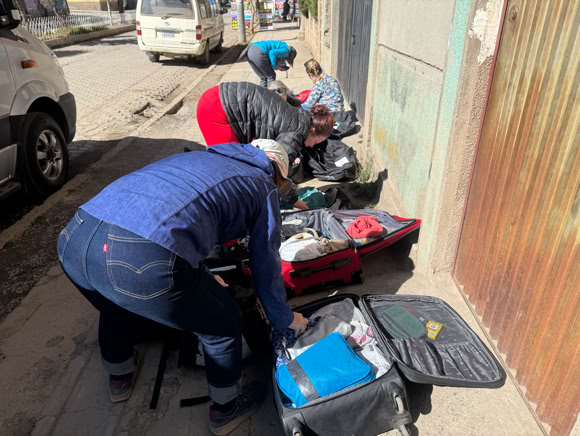
We returned the way we had come. First was the hour long boat trip from the island. We were reunited with the van and our luggage. Our guide had hoped that a cafe should allow us to repack inside, but the owners declined. So we had to wort out combining the contents of our duffel bags with our main cases on the pavement outside. We popped into the cafe to order something for our lunch.
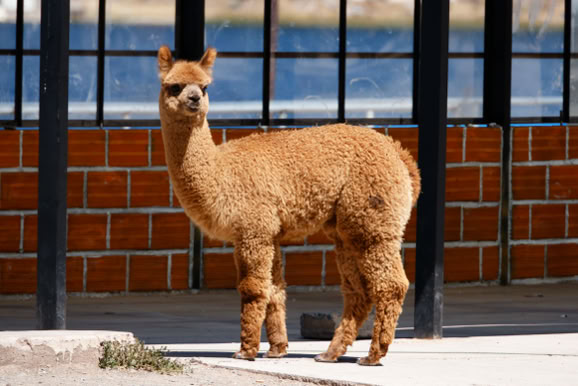
The van took us to our next crossing, the quick ten minutes by boat. We had to wait for our transport to cross, which gave me a chance to do some gift shopping at a road side stall. Three alpacas wandered past, two adults and a youngster. Their fluffy faces made them quite endearing.
We settled into a several hour drive. The countryside was quite flat, the buildings looked rather rough and ready. We saw lots of livestock, such as sheep and cows. Hay was in small twisted stacks or piled into what almost looked like buildings, square with a thatched roof.
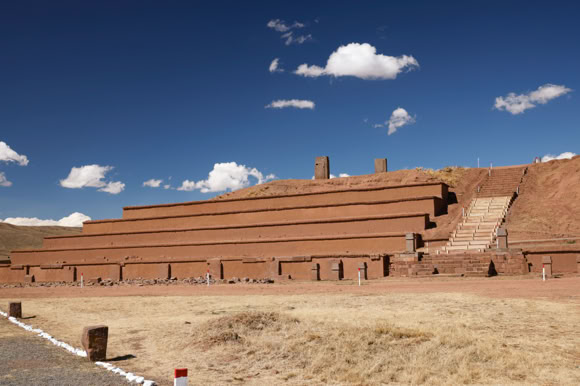
Mid afternoon we arrived at Tiwanaku. The site was established by a kingdom which predated the Inca, 400 - 900 CE. Much of what can be seen is a reconstruction, but archaeologists are undertaking digs to uncover more of the original buildings. The museum (which did not permit photography) was full of items across history. The pottery was particularly impressive. Many of the items were in the shape of animals and had been used for incense offerings.
We explored the site. ‘If you need walking poles, bring them,’ our guide said. Those of us who do use them pointed out that she’d advised us too late. We.d packed them in our main cases.
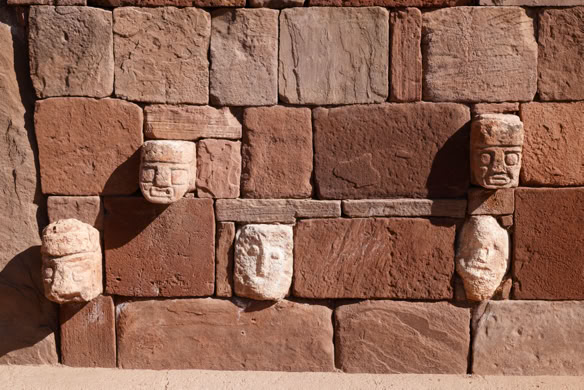
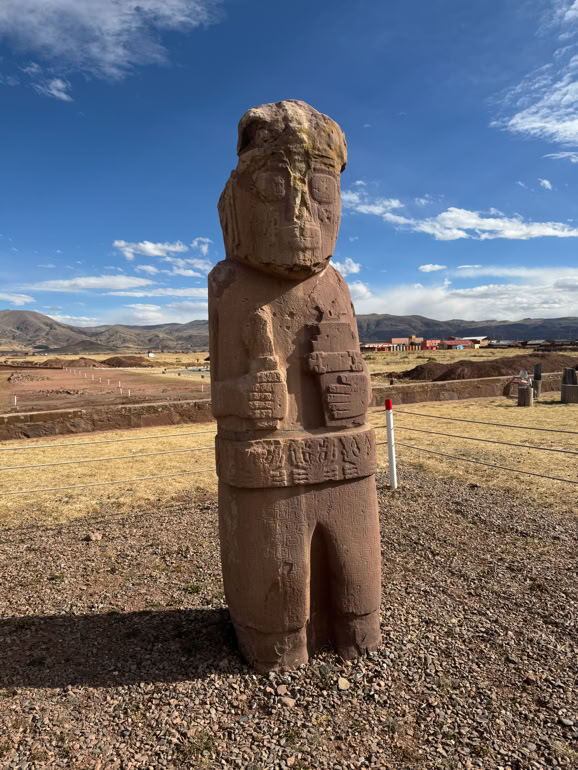
So I didn’t have my helper as we walked up steep steps and down gravel strewn paths. I was gasping for air, as we were again at 3,800 metres. At least I had a chance to recover whilst our guide explained what we were looking at, which included the foundations of houses and temples. There were also a number of statues, a misplaced Sun Gate, and walls set with rather charming stone faces. Their grimaces let me know that they felt my pain.
The van met us on the other side. After a quick toilet break, we headed to La Paz. As our flight wasn’t due to depart until 9.55pm, our guide insisted that we had time to drop into La Paz for dinner. Traffic was horrendous, which led to some people expressing concern whether we did have the time. We left the van to walk up to the Witches Market, where we ate at a supposedly Irish pub. I couldn’t quite see what made it Irish. I ordered sweet and sour chicken and once again talked myself out of drinking anything alcoholic.
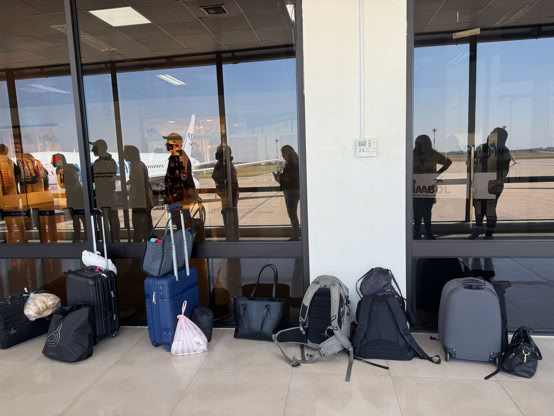
The food came rather quickly. We walked down through the Witches Market and boarded the van near the cathedral. By 8.30pm we’d arrived at the airport. We had plenty of time to drop off our bags and go through security, especially as our plane was delayed until 10.25pm.
La Paz is the world’s highest airport at 4,000 metres, and I began to feel less and less well as we waited. My head ached as if I were wearing a tightly fitting hat and dizziness set in. It was a relief to board the plane.
An hour later we landed at Santa Cruz, where we all enjoyed the ability to breathe properly once again. Our cases arrived quickly and we went outside to board our bus, arriving at our hotel around midnight. To our amusement, Sonja and I found we had a suite, with a sitting room, kitchen area, and two bedrooms. She kindly allowed me to have en-suite, with her using the bathroom which led off from the sitting area. I brushed teeth, changed into pyjamas, and collapsed into bed.
30 August
A good night’s sleep, although nose was showing after effects of so long at high altitude. A 9am departure meant that we could take time to have breakfast and pack for trips home. I decided to only have my camera backpack as carry on, so I did worry about the weight of my main bag. But when we checked in at the airport, it was only 23.2 kg against the 23kg limit, so I was fine.
To our surprise, we had to fill out the same governmental form as we’d completed to enter Bolivia. Sonja and I did so on paper whilst drinking flat whites. When we handed these in, the woman didn’t even look at them, just adding the papers to her collection.
On the other side of security, I used up my Bolivian currency on some last minute gift shopping. Boarding was a bit chaotic, as another flight was going from the gate next to ours and it wasn’t clear which queue was for each. After we went through, we had to place our bags on the floor and line up as a sniffer dog checked them out. Then we went to the plane.
I tried to nap on the flight, but my body insisted it was mid day and I should be awake. So I worked on photos and read a book. Just before midnight Bolivian time/5am Spanish time we landed in Madrid. After going through security, I bought something to eat before going on to my flight to England.
31 August
Again tried and failed to nap on the plane. My case was one of the first to arrive on the carousel. I made my way back home and by 1pm was in my house, opening windows to let in fresh air before unpacking my case. Holiday over!
I enjoyed what we saw in Bolivia, but Sonja and I both agreed that eleven days at high altitude was challenging and we’d not want to do it again!



If you’ve enjoyed reading my travel accounts, you might enjoy reading my books!
The first novel in my ‘Penny White’ fantasy series is only 99p for Kindle,
free on Kindle Unlimited, and also available in paperback.
Click on the image below to be taken to Amazon to buy your copy.
